New York · Journal
What the Light on Top of a New York City Taxi Means
How the roof light on a New York City yellow cab shows whether it is free, what the medallion number on it means, and why the off-duty light went away in 2013.

Every yellow cab in New York carries its medallion number in a light on its roof. When the number is lit, the cab is available for a hail. When it is dark, the cab has a passenger or the driver is off duty.
What the light says
The Taxi and Limousine Commission defines a roof light as “a light attached to the roof of a vehicle, or extending above the roofline of a vehicle, for the purpose of displaying information.” Every taxicab must have one. The meter runs it. Under TLC rules the light is on only when the taximeter is off, and dark while the meter is recording a fare. Owners may not tamper with it.

A driver taking a break or ending a shift enters an off-duty code into the cab’s meter system, which the TLC calls T-PEP. The code turns the roof light off. There is no separate switch. A driver who is on duty must take a passenger to any requested destination in the five boroughs, Nassau County or Westchester County.
One old practice stayed. At the end of a shift, a driver heading back to the garage or home may pick up a “going my way” passenger. The destination has to lie directly on the driver’s route, and the driver logs back on duty for that trip.
The number on the roof
The number belongs to the medallion. In TLC rules the medallion is “the numbered plate originally issued by the Commission and affixed to the outside of a Taxicab as physical evidence that the Taxicab has been licensed to operate as a Medallion Taxicab.” It gives the cab the right to take street hails anywhere in New York City. The rules define a taxicab as a motor vehicle, yellow in color, bearing a medallion.
The number goes on the front and the rear of the roof light, in letters 2¾ to 3 inches (7 to 7.6 cm) high and ½ inch (1.3 cm) thick. The owner must keep it clean and unobstructed so it is plainly visible. On accessible taxicabs, the New York State accessibility symbol may sit on both sides of the number. The same number goes on decals on both rear quarter panels, just below the rear windows. Inside, it is on the back of the front seat in figures at least 3 inches (7.6 cm) high, and on a plaque in raised lettering next to the word COMPLAINTS and a telephone number.
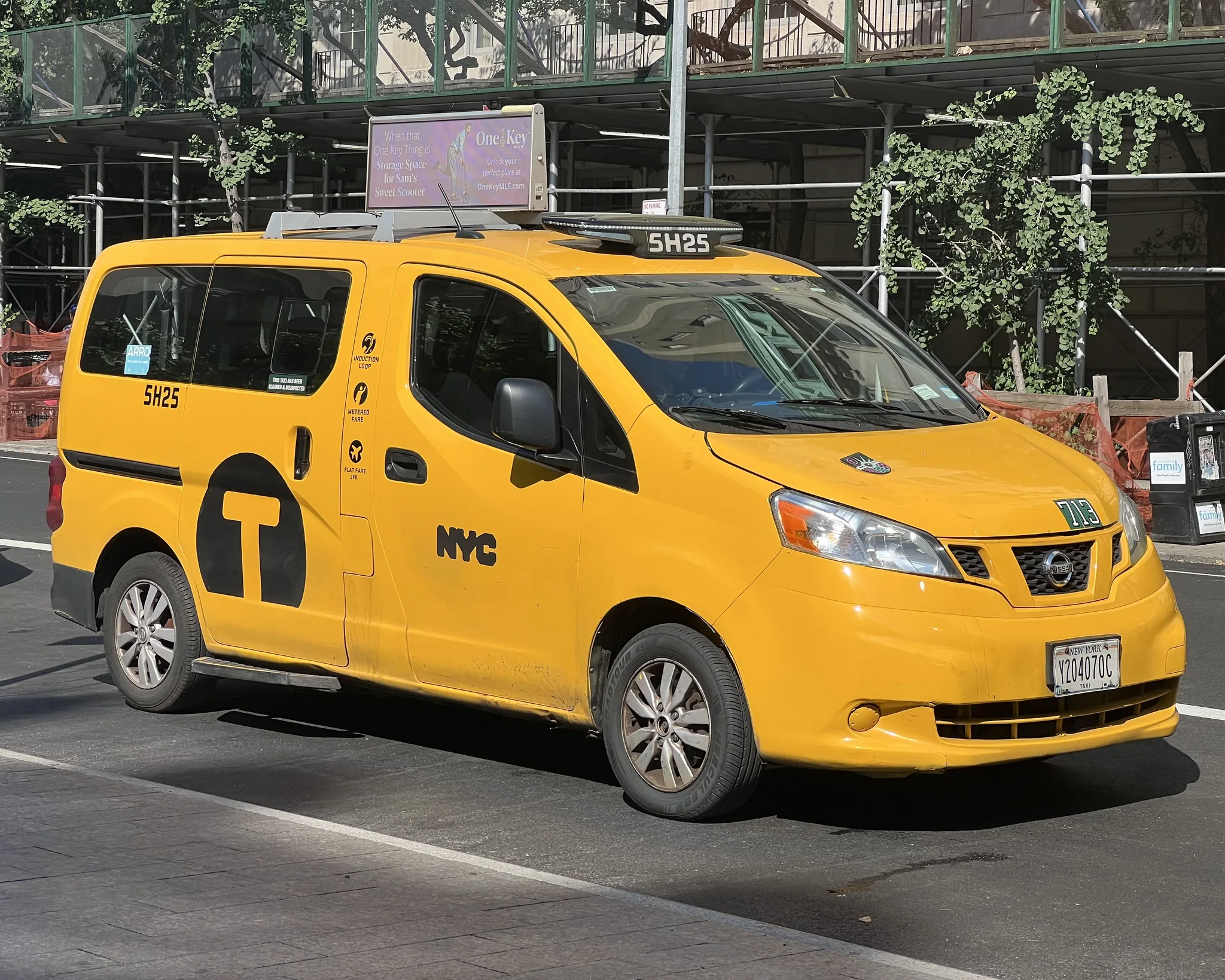
The hack-up rules call for wiring for a pair of turn-signal lamps next to the roof light. With a permit, an owner may use an authorized rooftop advertising fixture instead, a device that combines the roof light with advertising.
Four signals, then one
Until 2013 the roof light had two parts: the medallion number and an “off-duty” sign. The number went on and off with the meter. The off-duty sign ran from a manual switch on the dashboard. Together they made four signals:
- Number lit, sign dark: on duty and available.
- Both dark: on duty with a passenger already inside.
- Sign lit, number dark: off duty and carrying a “going my way” passenger.
- Both lit: off duty, but maybe available for a “going my way” trip.
In October 2011 the TLC, under Commissioner David Yassky, asked the industry for input. Its notice said some passengers, especially visitors, were confused. Some looked for any illumination on the roof and took it to mean the cab was free. The notice pointed to London, where taxis use a single light. In a 2012 TLC survey of 7,353 passengers, 37 percent said the roof light did not clearly show them whether a cab was available.
The commission named a second problem. Some drivers cruised with the off-duty sign lit to pick and choose passengers, and under TLC rules that is a refusal. The commission approved the single-light system on November 29, 2012. Cabs converted at their inspections in the first months of 2013. Owners could buy new roof lights or blacken the off-duty part of the old ones. The manual switch had to go.
Medallions and the yellow cab
Metered cabs came to New York in 1907, according to the city’s Department of Records. NPR, drawing on the historian Graham Hodges, credits a young financier named Harry N. Allen with importing the first ones from Europe. The word taxicab comes from taximeter, the instrument that measures distance and waiting time and computes the fare.
Early fleets came in many colors. TIME reports brown and white cabs, black ones, red ones and checkered ones, as well as yellow. It names two early yellow fleets: Albert Rockwell’s Yellow Taxicab Company in New York and John Hertz’s Yellow Cab Company in Chicago.
The medallion system began with the Haas Act of 1937, passed to deal with an overabundance of cabs. The TLC says the law froze the number of licenses at those in existence, 13,500. It set the split between corporate and independent medallions at 58 to 42. Active medallions fell to 11,787 in the 1940s. Auctions between 1996 and 2014 added hundreds more. Today the TLC licenses and regulates 13,587 medallion taxicabs.
A city law in the late 1960s made yellow the color of the medallion cab and required every other cab to be a different color. TIME, citing The New York Times, quotes Mayor John Lindsay in 1969: “The public must be provided with an easy means of rapid identification to distinguish between the licensed taxicabs and the non-licensed private liveries.” TLC rules now call for taxi yellow, Dupont M6284 or its equivalent, on everything but the trim.
The public must be provided with an easy means of rapid identification to distinguish between the licensed taxicabs and the non-licensed private liveries.
The Taxi and Limousine Commission itself was created in 1971. The city Comptroller reported in 2017 that it inspects every medallion cab three times a year.
Where to see it
On the street, in all five boroughs. In 2024 the TLC counted 10,870 medallion cabs active and completing trips. Each carries its number on the front and rear of its roof light.
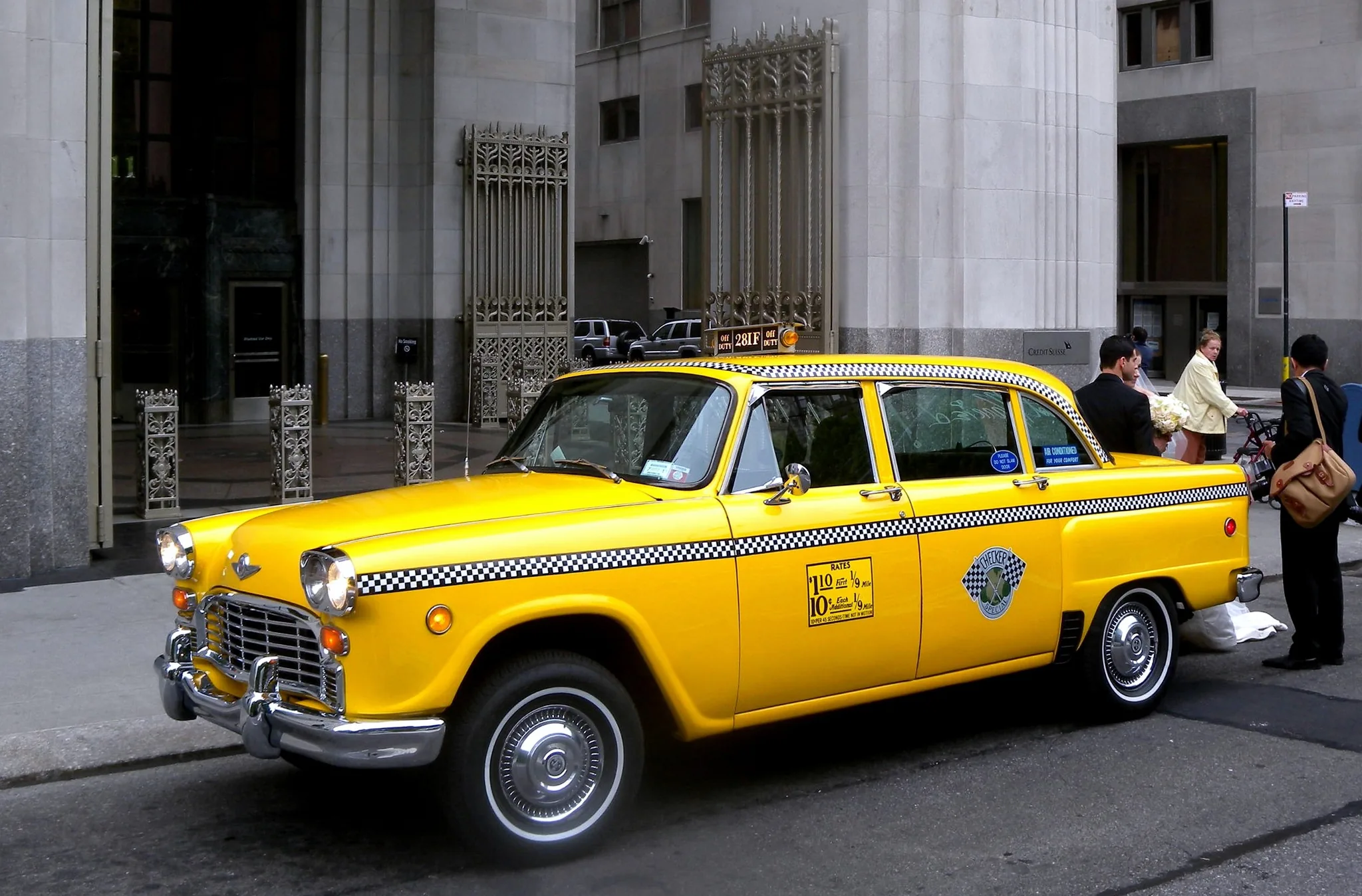
The older two-part light survives at The Henry Ford museum in Dearborn, Michigan. A 1981 Checker Marathon taxicab, catalogued under New York, New York, stands in its Driving America exhibit. The museum records the lettering on its roof light box as “OFF / DUTY / 8P96 / OFF / DUTY,” a number between two off-duty signs. Its door decal lists the rates: $1.15 for the first eighth of a mile (0.2 km), 15 cents for each additional eighth. The museum notes that the Checker’s basic design dated to 1956 and stayed substantially unchanged until production ended in 1982.
The song
The Roof Light
Synth-pop · new wave · 2:29
In the collection
 New York № 001 The Roof Light A number on the roof. A light that says available. See The Roof Light →
Sources
- Chapter 51: Definitions (updated October 17, 2025) — NYC Taxi and Limousine Commission Rules
- Chapter 58: Medallion Taxicab Service — NYC Taxi and Limousine Commission Rules
- Chapter 67: Rules for Taxicab Hack-Up and Maintenance — NYC Taxi and Limousine Commission Rules
- Industry Notice #11-25: Request for Input on Yellow Taxicab Roof Lights (October 11, 2011) — NYC Taxi and Limousine Commission
- Notice of Promulgation of Rules: elimination of the off duty roof light — NYC Taxi and Limousine Commission
- Industry Notice #12-56: Required Changes to Medallion Taxicab Roof Light (December 19, 2012) — NYC Taxi and Limousine Commission
- 2012 Annual Report — NYC Taxi and Limousine Commission
- Testimony of Meera Joshi, Intro Nos. 1474 & 1475 (February 27, 2017) — NYC Taxi and Limousine Commission
- Testimony of Ashwini Chhabra, Intros 923, 929-A, 930 (2012) — NYC Taxi and Limousine Commission
- Office of Financial Stability Annual Report 2024 — NYC Taxi and Limousine Commission
- About TLC — NYC Taxi and Limousine Commission
- Audit Report on the New York City Taxi and Limousine Commission's Oversight over Its Revenue Collection Practices (FM17-082A) — Office of the New York City Comptroller
- City Hall Library Notes, June 2012: Spotlight on Taxicabs — NYC Department of Records and Information Services
- Hailing the History of New York's Yellow Cabs (July 8, 2007) — NPR
- Why Are Taxi Cabs Yellow? The True Story Behind the Color (May 2, 2017) — TIME
- taxicab — The American Heritage Dictionary of the English Language
- taximeter — The American Heritage Dictionary of the English Language
- 1981 Checker Marathon Taxicab — The Henry Ford
Images
- Opening photograph: Clément Bardot, CC BY-SA 4.0, via Wikimedia Commons
- A yellow Nissan NV200 taxi seen from the front quarter, with the number 5H25 on its roof light and on the rear panel.: S5A-0043, CC BY 4.0, via Wikimedia Commons
- A restored yellow Checker cab with a checkered stripe parked on Madison Avenue in front of a stone building.: Jim.henderson, CC0, via Wikimedia Commons


