New York · Journal
New York Subway Handrails: From Leather Straps to Poles and Bars
How the poles and bars in New York subway cars replaced leather straps, what federal rules require of them, and where to ride cars that still have straps.

New York subway cars are fitted with poles and bars for the riders who stand. Earlier cars gave those riders straps, and the name stayed: New Yorkers are still called straphangers. Leather straps still hang in the New York Transit Museum’s vintage cars, which carry riders on special trips.
What the handrails are for
Federal accessibility rules for rapid-rail cars state the purpose in one sentence. “Handrails and stanchions shall be provided to assist safe boarding, on-board circulation, seating and standing assistance, and alighting by persons with disabilities.” A stanchion is an upright pole. The rule, section 38.57 of Title 49 of the Code of Federal Regulations, calls for “ample vertical stanchions from ceiling to seat-back rails.” Poles that run from floor to ceiling must not block wheelchair users and must be kept to a minimum near the doors.
The rule also sets the size of the grip. A handrail or stanchion must be 1¼ to 1½ inches (3.2 to 3.8 cm) across, or offer an equivalent grip, with at least 1½ inches (3.8 cm) of clearance for the knuckles from the nearest surface.

From straps to bars
The American Heritage Dictionary defines a straphanger as “one who grips a hanging strap or similar device for support while riding as a passenger on a bus or subway.” Its second sense is anyone who uses public transportation. The Smithsonian’s Center for Folklife and Cultural Heritage writes that New York commuters have carried the nickname since the early 1900s.
Those straps hung “from train ceilings and overhead handrails to provide extra handholds for passengers on crowded trains,” the Smithsonian notes, and in earlier models they were leather. The Transit Museum writes that most elevated cars in New York and Brooklyn looked like its BU cars, built in the early 1900s, with rattan seat cushions, leather straps and bare incandescent bulbs. A museum photograph of a BMT Standard train from about the 1950s shows porcelain grab handles.
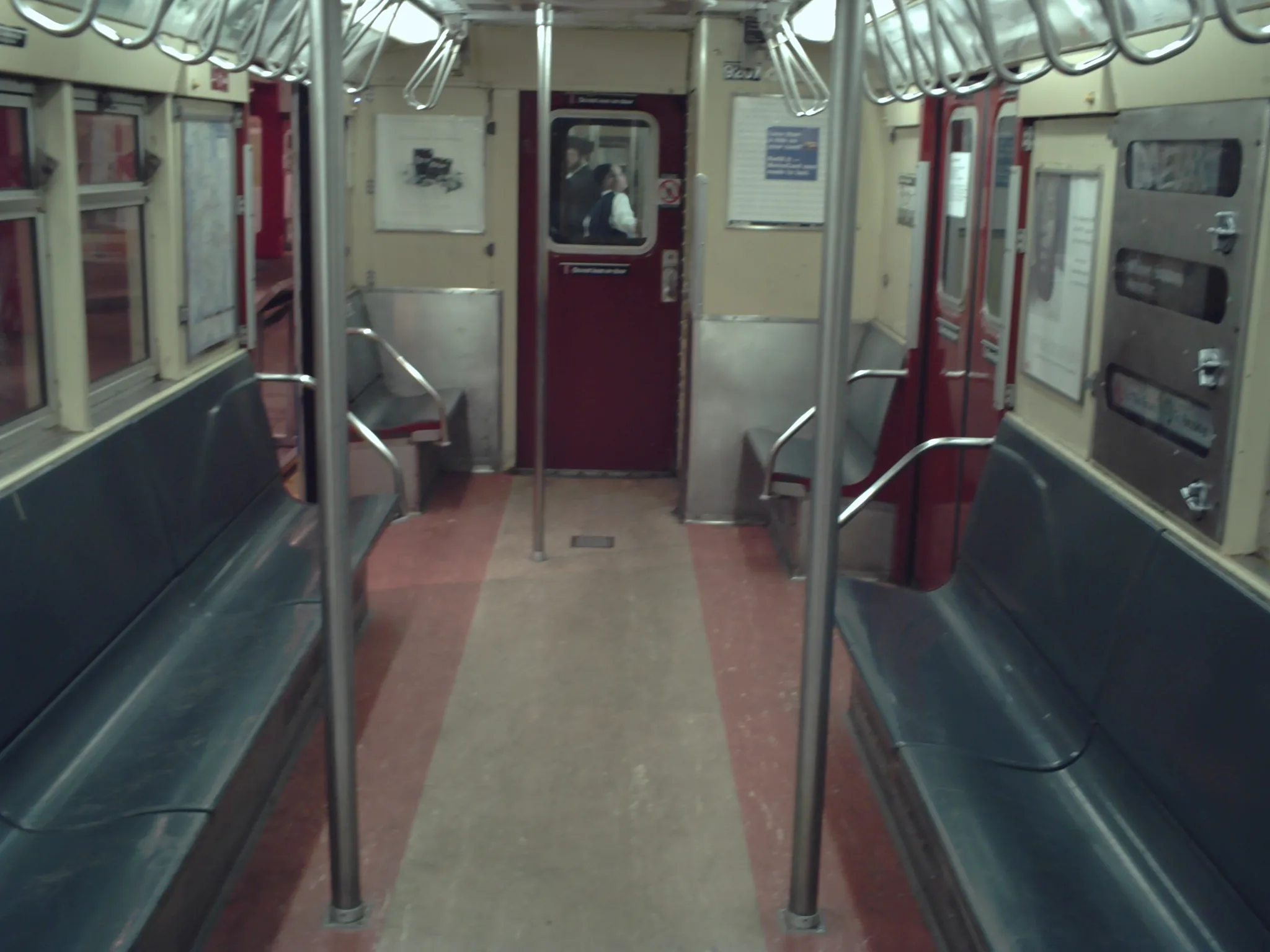
Later straps were metal. The Smithsonian keeps one from a Redbird, an R-33 car built by the St. Louis Car Company in the 1960s. It has a flat top holding a stirrup-shaped length of metal tubing, set at a forty-five-degree angle, “allowing standing passengers to sway with the motion of the train.” MTA workers, the Smithsonian adds, call a car packed with people holding straps a “swinging load.”
Steel cars, then stainless
Steel came to the car body early. The Transit Museum records that the first subway cars combined wood and steel. Alexander Cassatt, president of the Pennsylvania Railroad, considered wooden cars a fire hazard. He asked his chief engineer, George Gibbs, to help the Interborough Rapid Transit Company build an all-steel car. The IRT’s first all-steel cars went into service in 1904, shortly after the first subway line opened.
Stainless steel arrived in quantity six decades later. The R-32 was the first large fleet of mass-produced stainless-steel cars bought by New York City Transit: 600 cars, built in Philadelphia by the Budd Company. The first train carried passengers on September 14, 1964. They were nicknamed Brightliners for their washboard-like stainless exteriors. Each cost $114,700, and the MTA notes they were much lighter than earlier subway cars.
Painted cars ran alongside them for decades. Nearly 2,000 cars delivered between 1959 and 1964 became the Redbirds, named for the Fox Red paint they wore from 1984 until they retired in 2003. The museum calls that red “the last fully painted exterior in New York Subway history.”
Testing the grip
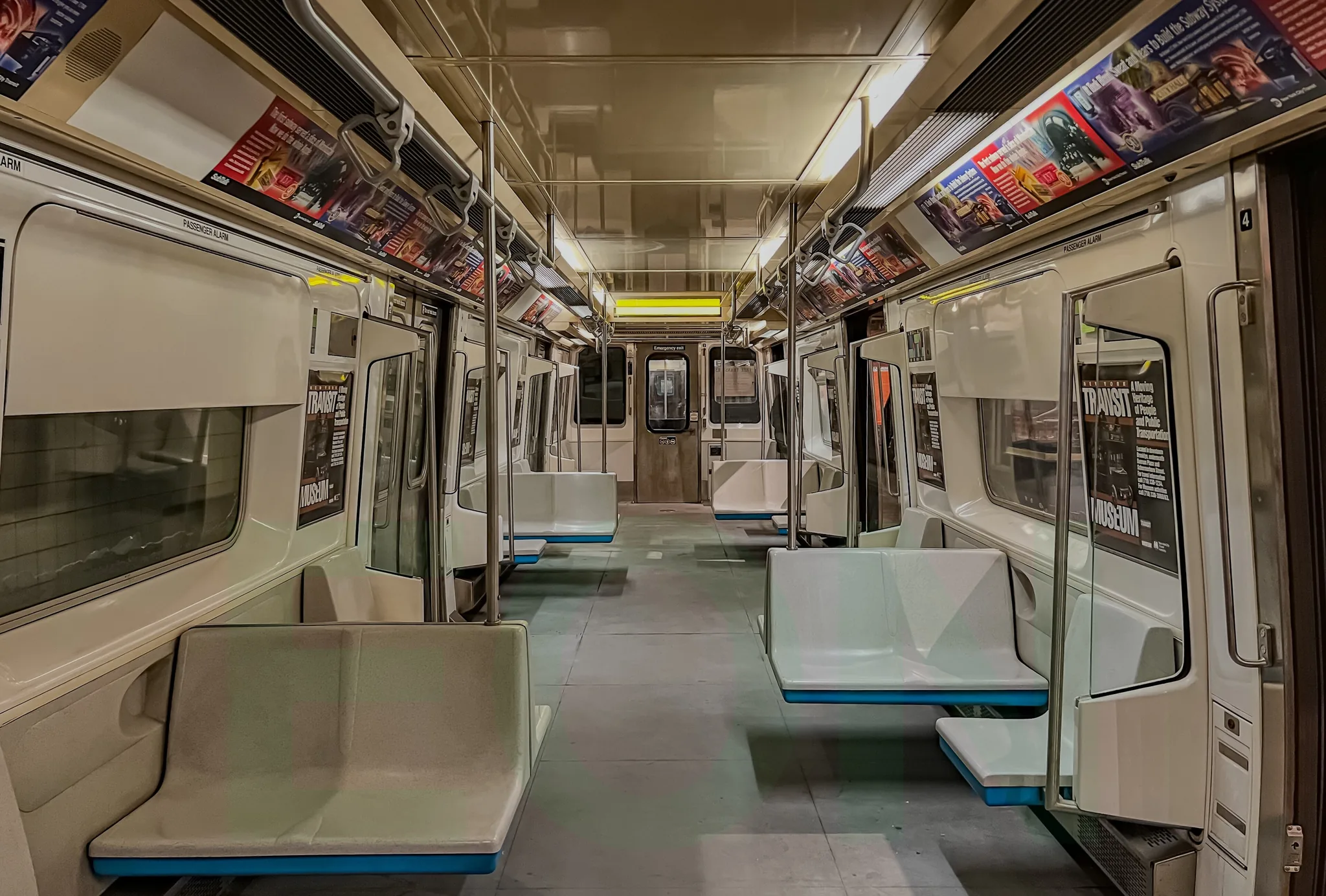
Before its next large order, New York City Transit put test trains in front of riders. Kawasaki built ten R110A cars and Bombardier built nine R110B cars, and the R110Bs entered service on the A train on June 15, 1993. The cars were deliberately not identical. They tried different seat colors, floor materials, electronic signs, windscreens and handholds to see what worked. On test runs, passengers could speak directly to agency and vendor staff on board. Wider doors cost about 20 seats per car and added room for people standing, which riders met with, in the museum’s words, “resounding disapproval.”
Many of the features tested went into the New Technology Trains: the R142, the R179 and the R211. The R211 has door openings 58 inches (147 cm) wide, eight inches (20 cm) wider than on older cars. Twenty cars of the original 535-car order are open-gangway cars, joined by soft, accordion-like walls so riders can walk from one car to the next. The museum’s BMT D-Type Triplex of 1925 was the first articulated open-gangway rapid transit car in the United States.
Hands on the bar
In the summer of 2013, researchers at Weill Cornell Medical College swabbed every open subway station, 466 of them, as part of 1,457 samples taken across the city. Inside the trains, they wrote, “the doors, poles, handrails, and seats were swabbed.”
In 2020, cleaning them became a daily job. On April 30, Governor Andrew Cuomo announced that trains would be disinfected every day. “You have to disinfect every place that a hand could touch on a subway car,” he said. “Every rail, every pole, every door.” Beginning May 6, 2020, the subway closed from 1 a.m. to 5 a.m. each night for the work. Federal Transit Administration guidance cited by the MTA listed poles, handrails and grab bars among the high-touch surfaces to keep disinfecting. In May 2021 the MTA announced that 24-hour service would resume on May 17.
You have to disinfect every place that a hand could touch on a subway car.
Where to see it
In any subway car. For the older grips, the New York Transit Museum is at 99 Schermerhorn Street in Brooklyn, in a decommissioned 1936 subway station. Its platform runs a full city block, and about 20 vintage cars are on view at any time, rotating through the year. The collection includes car 8013, an R11 prototype built by Budd in 1949, and car 9306, one of the blue-and-white World’s Fair cars of 1963, kept on the platform in its 1970s state. A team of museum volunteers works with New York City Transit’s Car Equipment department to prepare the fleet, and each car used on a ride passes the same safety testing as any car in revenue service.
Throughout the year the museum runs Nostalgia Rides on its vintage trains, where riders can “grip old handholds and leather straps.” Each December, the museum and MTA New York City Transit run a Holiday Nostalgia Train of eight cars from the 1930s, free with a subway fare. Timing, routes and equipment are subject to change, the museum notes.
The song
The Handrail
Afrobeats pop · 2:29
On the map
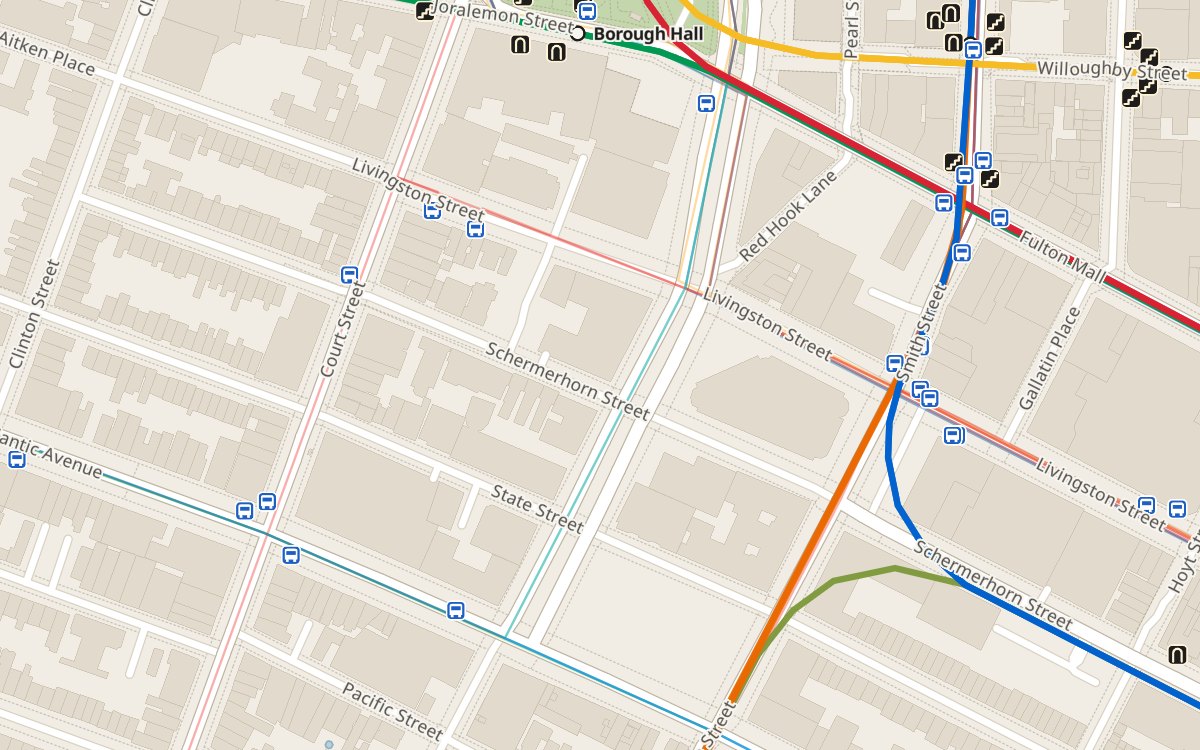
New York Transit Museum, Brooklyn. Open The Atlas →
Map: OpenFreeMap · © OpenStreetMap contributors
In the collection
 New York № 001 The Handrail Leather straps became poles and bars. The name stayed. See The Handrail →
Sources
- 49 CFR § 38.57 Interior circulation, handrails and stanchions — Electronic Code of Federal Regulations
- stanchion — The American Heritage Dictionary of the English Language
- straphanger — The American Heritage Dictionary of the English Language
- Subway Car Strap — Smithsonian Folklife Festival, Smithsonian Center for Folklife and Cultural Heritage
- Vintage Fleet: Meet the BU Cars — New York Transit Museum
- Digital Discussion – Sit, Stand, Lean, Hang — New York Transit Museum
- Meet the Bluebirds and Redbirds — New York Transit Museum
- MTA to Retire 1960s-Era Subway Cars With Celebratory Final Runs — MTA
- Saying goodbye to the R32, aka the "Brightliner" — MTA
- R32 Retirement Runs — New York Transit Museum
- Nostalgia Ride: Celebrating the Brightliners — New York Transit Museum
- Vintage Fleet: Meet the R110B — New York Transit Museum
- MTA Unveils New R211 Subway Cars — MTA
- First R211 Subway Cars Roll Into Service on the A Line — MTA
- About the Trains – Parade of Trains — New York Transit Museum
- Geospatial Resolution of Human and Bacterial Diversity with City-Scale Metagenomics — Cell Systems (2015), PubMed Central
- Amid Ongoing COVID-19 Pandemic, Governor Cuomo and Mayor de Blasio Announce MTA to Disinfect New York City Transit System Daily (transcript) — Office of the Governor of New York
- ICYMI: Governor Cuomo Announces MTA to Partially Restore Overnight Subway Service — MTA
- ICYMI: Governor Cuomo Announces New York City Subway Will Resume 24 Hour Service Beginning May 17 — MTA
- About Us — New York Transit Museum
- Know Before You Visit — New York Transit Museum
- Vintage Fleet — New York Transit Museum
- Nostalgia Rides — New York Transit Museum
- Holiday Nostalgia Rides — New York Transit Museum
Images
- Opening photograph: Eric Fischer, CC BY 2.0, via Wikimedia Commons
- The inside of an R33 World's Fair subway car with benches along the walls and stainless-steel poles and handrails.: bebo2good1, CC BY-SA 4.0, via Wikimedia Commons
- The interior of an R110B subway car with white and blue seats, vertical poles and wide doors.: EmperorOfNYC, CC BY 4.0, via Wikimedia Commons


