New York · Journal
Bodega Cats: Why New York Corner Stores Keep Cats, and What the Law Says
Why New York bodegas keep cats, where the word bodega comes from, what state and city food rules say about live animals, and the bills to change them.

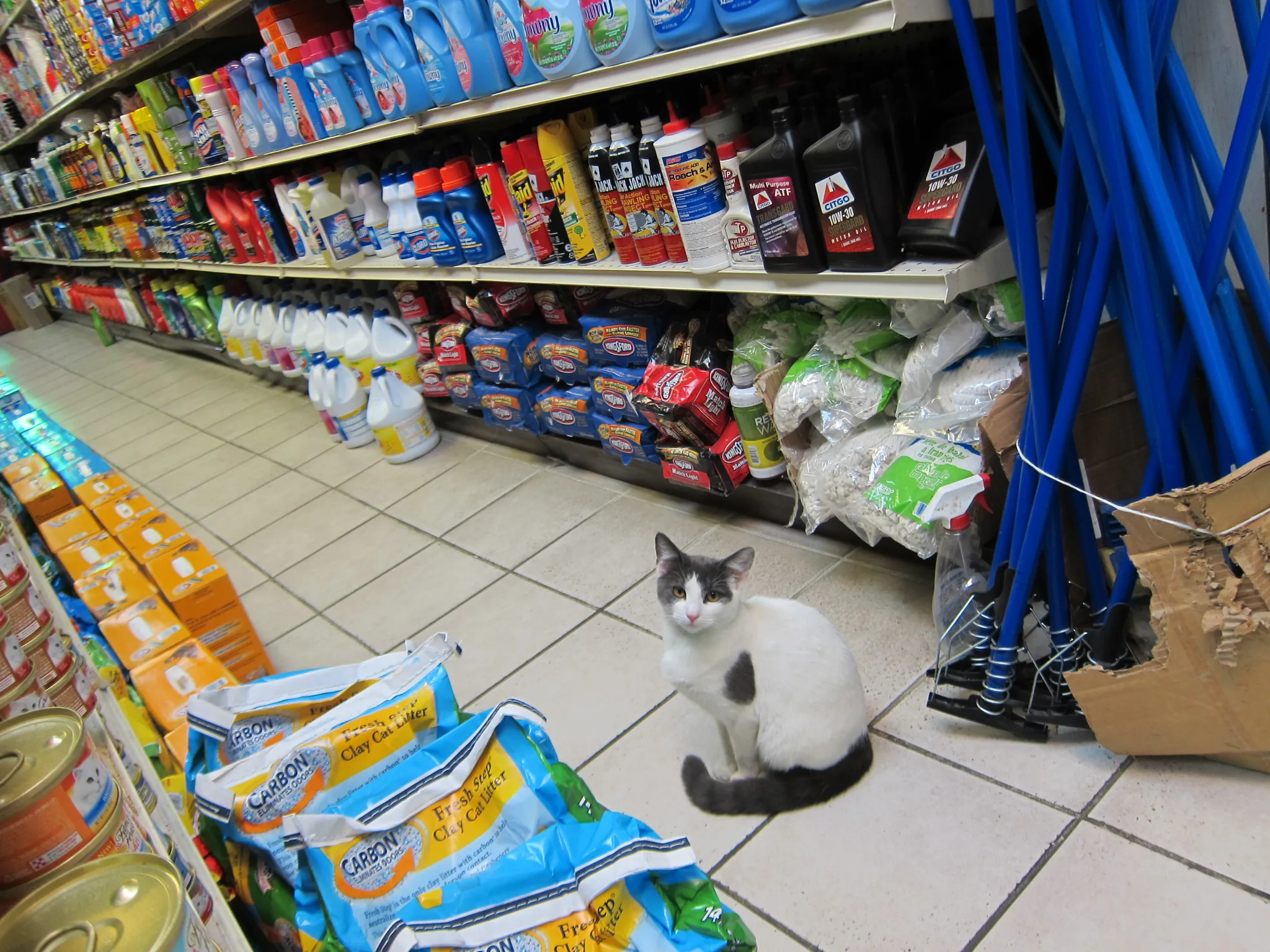
In a New York bodega, the cat is often on the counter, on a shelf or on a case of beer. Owners keep cats to deal with rodents and to bring in customers. Under the state’s rules for food stores, the cat is not supposed to be there at all.
The bodega
Merriam-Webster defines a bodega as “a usually small grocery store in an urban area,” and specifically “one specializing in Hispanic groceries.” The American Heritage Dictionary gives “a small grocery store that specializes in products from the Caribbean and Latin America.” Etymonline adds that since the 1970s the word has meant a “corner convenience store or grocery” in American English, and that in New York City it is used generically.
The word is Spanish, and its older meanings have to do with wine. Merriam-Webster’s first sense is “a storehouse for maturing wine,” followed by wineshop and barroom. Behind it is the Latin apotheca, “storehouse.” The same Latin word gave English apothecary and French boutique.
The stores and the people behind the counter
The New York bodega grew with the Puerto Rican migration after World War II. The Center for Puerto Rican Studies at Hunter College calls it “emblematic of the Puerto Rican migrant experience after World War II.” NPR dates bodega culture to the 1940s and ’50s, when Carlos Sanabria’s family made almost daily runs down the street for milk, eggs, beans and rice. Many of the new stores were run by Puerto Rican families who named them after places on the island. Sanabria grew up on the Lower East Side and later taught Caribbean history. In his book on the stores, he writes that “bodegas were places where friends and neighbors would meet up to socialize.”
The shelves needed a supplier. In 1936 Prudencio Unanue and his wife, Carolina Casal, opened a warehouse on Duane Street in lower Manhattan “to supply corner stores or bodegas,” according to the Smithsonian’s National Museum of American History. The business took the name Goya Foods in 1961.
In the 1950s and ’60s, owners applying for a New York State liquor license had to submit photographs of their stores. The Cuban photographer Justo Martí took nearly 200 of them, inside and out, for the Puerto Rican Merchant Association.
Bodegas were places where friends and neighbors would meet up to socialize.
The owners changed over time. In 2017 NPR met a bodega owner born in the Dominican Republic, Merquis Garcia of A & M Supermarket in the Bronx, who said that at home such a store was called a colmado. Abdul Sulaimani’s family has run Yafa Newsstand & Deli in Brooklyn for more than two decades and named it after their home region in Yemen. His father, he said, “learned Spanish before he learned English well enough just because of working behind a counter.” On the Lower East Side, Shoyel Abdul works at L.E.S. Mini Mart, owned by an immigrant from Bangladesh, across the street from the Latino-owned bodega where he used to stop for breakfast before school.
Why the cat is there
“In many of them, you’ll find a cat to eliminate rodents and attract customers,” NPR reported in 2025. The Associated Press heard both reasons. Fans say the cats help keep stores clean by deterring rodents and cockroaches. Some shopkeepers told AP that bringing in customers matters more.
At one Greenpoint bodega, a gray and white cat named Mimi became a bigger attraction after a customer, Sydney Miller, posted a TikTok video of her that was viewed more than 9 million times. Her caretaker, Asam Mohammad, is a Yemeni immigrant. One of her kittens, Lionel, lives at a nearby bodega owned by the same family. At another Greenpoint store, Salim Yafai said a longtime customer once tried to buy his cat, Reilly. “I said $10,000. He said $1,000. I said, ‘No.’”
Whether cats control rats is a separate question. In 2018 researchers from Fordham University and the University of Sydney published a study of feral cats and a rat colony at a waste recycling site in Brooklyn. Over 79 days of video they recorded 20 stalking events and three predation attempts, two of them successful. Rats were seen less often on days with more cats, but the colony stayed. The study was about rats, not mice. Its authors note that mice weigh 20 to 35 grams and city rats often weigh ten times as much.
What the rules say
In New York State, stores that sell food for people to take home are licensed as retail food stores by the Department of Agriculture and Markets. “Inspecting bodegas is a state responsibility,” AP reported. The department’s rule, Section 271-7.30 of Title 1 of the state regulations, reads: “Live animals shall be excluded from within the retail food store operational areas and from immediately adjacent areas inside the store.” The exceptions are edible fish, crustacea, shellfish and fish in aquariums, patrol dogs in offices and storage areas, and guide dogs in sales areas. Cats are not on the list. In a statement to AP, the department said its inspectors aim to offer “educational resources and corrective action timelines and options” before looking at fines.
Live animals shall be excluded from within the retail food store operational areas.
City rules cover restaurants and other food service establishments. Section 81.25 of the New York City Health Code reads: “No live animal shall be kept, housed or permitted to enter into or remain in any food service establishment.” It allows edible fish, crustacea and mollusks, aquarium fish, service dogs and police working dogs. According to the City Council’s own summary, the city Health Code also prohibits owners of retail food stores from keeping a cat.
The bills
By April 2025 an online petition asking the city to shield bodega cat owners from fines had passed 10,000 signatures, AP reported. On November 12, 2025, Council Member Keith Powers and five colleagues introduced Int. 1471. It said that no city law or agency rule “shall be construed as prohibiting the keeping of a live cat in a retail food store.” It also directed the Office of Animal Welfare, working with the Department of Small Business Services, to offer free vaccinations and spaying and neutering for store cats. The bill was filed at the end of the Council session on December 31, 2025.
Council Member Frank Morano reintroduced it as Int. 830 on April 16, 2026, with Council Member Virginia Maloney and Public Advocate Jumaane Williams. As of September 2026 it sits in the Committee on Health. The Council’s summary states the limit: “this bill standing alone would not permit store owners to keep cats in their stores.” The state would have to change its own rule.
A state bill, A8341, sponsored by Assembly Member Rosenthal, would direct the Department of Agriculture and Markets to set “responsible care standards” for cats in retail food stores. They would include veterinary checkups and vaccinations, mandatory spaying or neutering, and a “cat zone” kept apart from food preparation and storage. The bill was referred to the Assembly’s agriculture committee in May 2025 and again in January 2026.
Where to see it
The stores of the 1950s and ’60s survive in Martí’s liquor-license photographs. They belong to the Justo Martí Photographic Collection, which also holds more than 30,000 negatives and four to six thousand photographs. It was donated to the Center for Puerto Rican Studies in 1984 and is kept in its library and archives in East Harlem.
Bodega cats live in stores across the city, and they come and go. In March 2025, AP photographers found Marshmellow on a shelf under the cookies at Deli & Grill on the Upper East Side, Elias on the checkout counter at Stars Deli in Williamsburg, and Pepelito on a case of Italian beer at NY Grill & Deli.
The song
The Bodega Cat
Urban bachata · 2:29
On the map
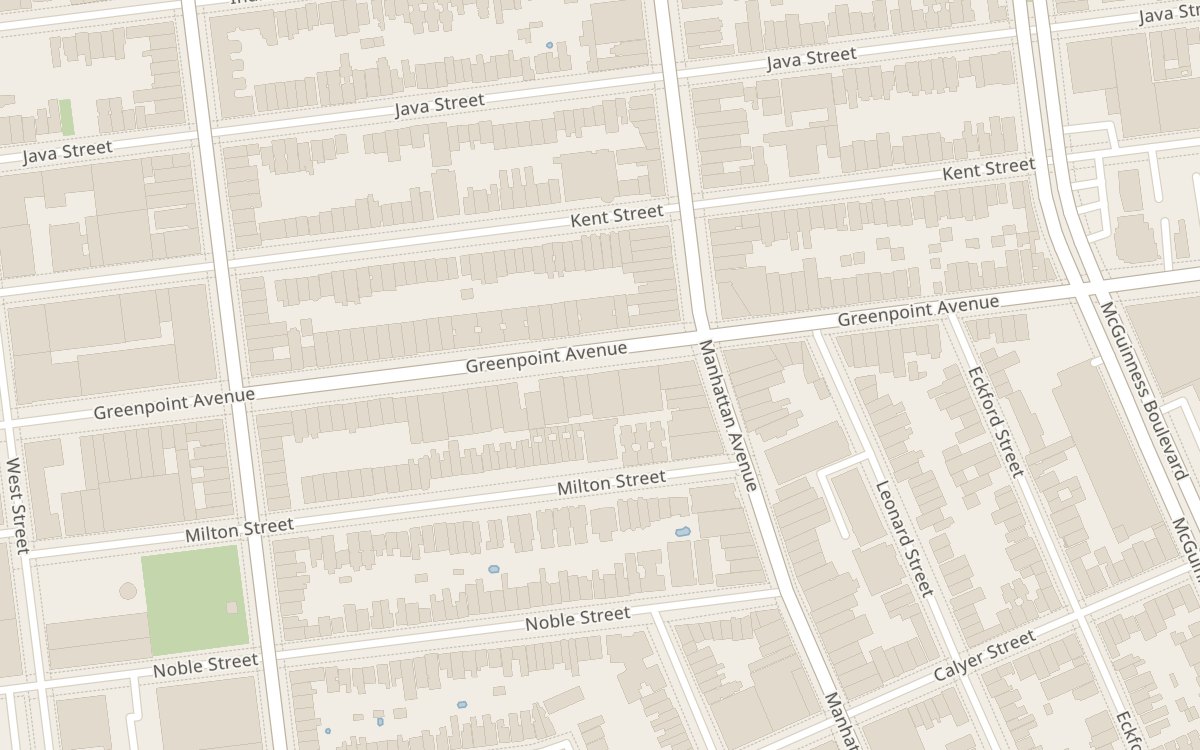
Greenpoint bodegas, Brooklyn. Open The Atlas →
Map: OpenFreeMap · © OpenStreetMap contributors
In the collection
 New York № 001 The Bodega Cat A shopkeeper’s helper. A neighborhood regular. See The Bodega Cat →
Sources
- Bodega Definition & Meaning — Merriam-Webster
- bodega — The American Heritage Dictionary of the English Language
- bodega (n.) — Online Etymology Dictionary
- The Legacy of the Puerto Rican Bodega — Center for Puerto Rican Studies, Hunter College (CUNY)
- New York City Bodegas And The Generations Who Love Them — NPR
- Goya Foods, Inc. Collection — Archives Center, National Museum of American History, Smithsonian Institution
- Bodega cats aren't just cute; some in N.Y. also consider them working animals — NPR
- Bodega cats make New Yorkers' hearts purr, even if they violate state regulations — Associated Press (via Spectrum News)
- Temporal and Space-Use Changes by Rats in Response to Predation by Feral Cats in an Urban Ecosystem — Frontiers in Ecology and Evolution
- Food Business Licensing — New York State Department of Agriculture and Markets
- Circular 962: Rules and Regulations Relating to Retail Food Stores (1 NYCRR Part 271) — New York State Department of Agriculture and Markets
- New York City Health Code, Article 81: Food Preparation and Food Establishments — NYC Department of Health and Mental Hygiene
- Int 1471-2025: Cats in retail food stores — New York City Council
- Int 0830-2026: Cats in retail food stores — New York City Council
- Int. 830 Memorandum in Support of Legislation — New York City Council
- City Council member introduces bill that would legalize bodega cats — Spectrum News NY1
- A08341: Health and safety guidelines for cats living in retail food stores — New York State Assembly
Images
- Opening photograph: Deans Charbal, CC BY-SA 4.0, via Wikimedia Commons
- A gray and white cat sitting on a tiled floor between shelves of cleaning products and bags of cat litter.: Seth Werkheiser, CC BY-SA 2.0, via Wikimedia Commons

