New York · Journal
New York City Fire Hydrants: Who Makes Them and Who Keeps Them Working
How New York City's fire hydrants are built and painted, who inspects and repairs them, how the free spray cap works, and where their history can be seen.

New York City has more than 109,000 fire hydrants, and the Department of Environmental Protection lists every one in a public dataset. Firefighters open them to fight fires, DEP crews repair and paint them, and on hot days neighbors ask the local firehouse to fit one with a spray cap. The hydrant on the corner is built to a city specification, down to the paint on its top.
What stands on the curb
DEP’s specification covers two kinds of dry-barrel hydrant. One is the Dresser type, designated D-2-LP. The other is the Smith type, S-2-LP. New hydrants set on city projects must be one of the two, in a two-piece “breakaway” design. City construction contracts carry a separate item for the Smith type, marked for historic districts.

The castings are ductile iron. The nozzle section, the nozzle caps and the lower standpipe are coated in black polyurethane. The bonnet on top is silver or aluminum-colored. Each hydrant carries the cast letters WSNY and a metal tag with its own serial number.
Installers set each hydrant plumb, with its nozzles facing the curb at 45 degrees. The main valve opens when the operating nut is turned clockwise. The maker warrants the hydrant for ten years.
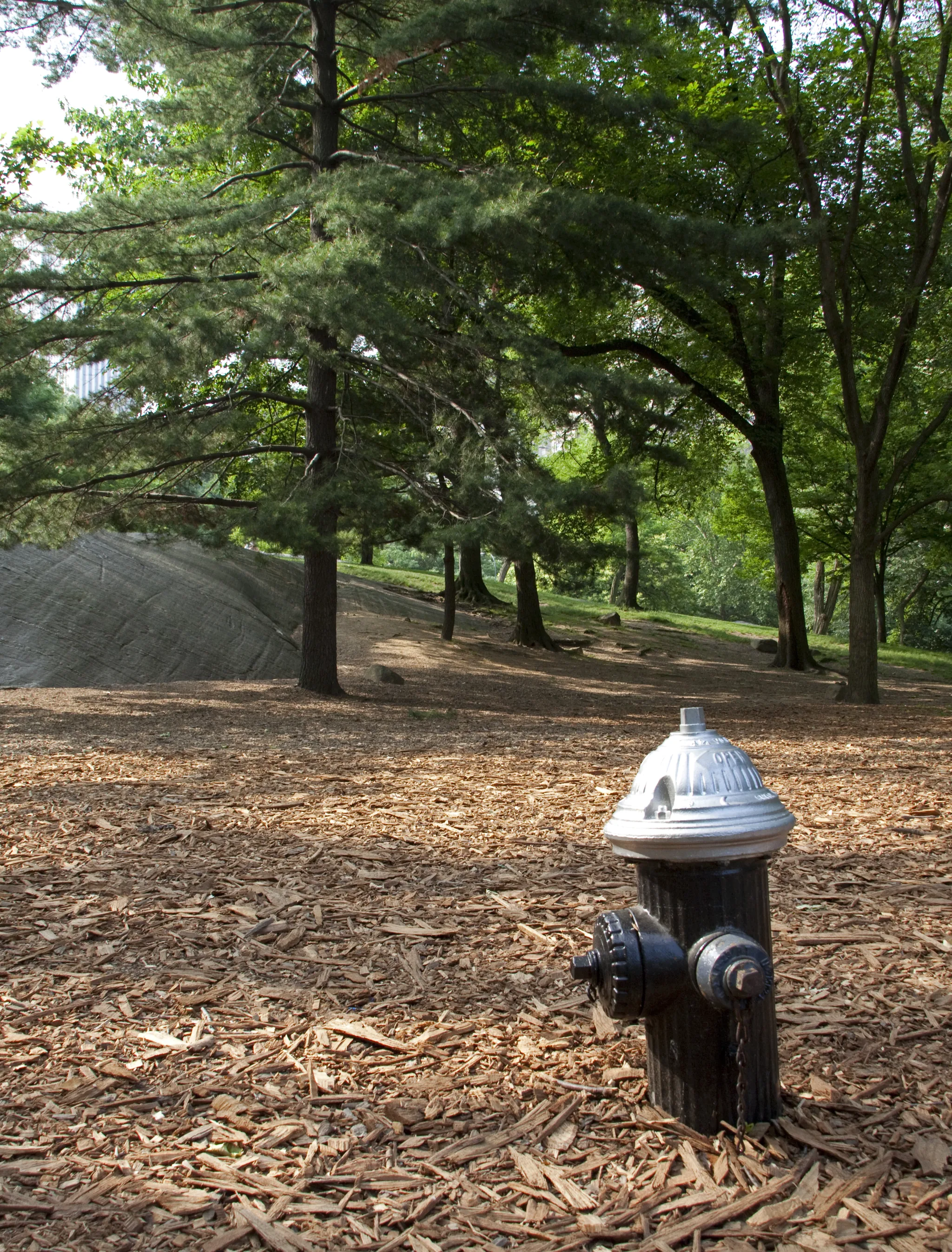
DEP lists three approved manufacturers: United States Pipe & Foundry Company, Mueller Company, and M&H Valve, which is approved for the Dresser type. Every foundry that casts city hydrants is subject to DEP inspection and approval. Wherever the parts are made, the finished hydrants are tested in the United States in front of city inspectors.
Inspections and repairs
DEP’s Bureau of Water and Sewer Operations runs the water system and answers hydrant complaints. In a 2011 safety alert, DEP put the count at approximately 109,000 hydrants. The city Comptroller counted 109,586 as of June 30, 2019. That fiscal year the bureau opened 27,641 hydrant repair work orders, and the work went to DEP repair yards in the boroughs where the hydrants stand.
Firefighters check every hydrant. Local Law 112 of 2018 requires the Fire Department to inspect all DEP hydrants at least twice a year, once by June 30 and again by December 31. The FDNY marks some as priority hydrants: those near hospitals, day care centers, schools, senior-citizen housing and large places of public assembly, and any hydrant that is the only one on its block. For fiscal 2019, DEP reported repairing inoperative priority hydrants in an average of 2.5 days.
DEP paints hydrants on a regular maintenance schedule and does not take painting requests. It also weighs requests for fender posts, based on the type of hydrant and its location.
City rules say hydrants may be routinely opened only by DEP and Fire Department employees. Anyone else needs a DEP permit and an approved hydrant wrench, and the hydrant must stay available to the Fire Department at all times. For drivers the rule is simpler: no parking within 15 feet (4.6 m) of either side of a hydrant. In February 2025 the FDNY said firefighters at a Brooklyn fire were delayed because two cars blocked the two hydrants closest to the burning building.
The spray cap
A hydrant opened without a cap generally releases more than 1,000 gallons (3,800 liters) of water a minute. DEP says that lowers water pressure, makes firefighting harder, and can knock a child down. A City-approved spray cap cuts the flow to 20 to 25 gallons (76 to 95 liters) a minute.
The cap is free. An adult asks at the local firehouse, shows ID and fills out a form. The firehouse schedules a time to turn the hydrant on and off. Opening a hydrant illegally can bring a fine of up to $1,000, up to 30 days in jail, or both.
DEP has also sent young people out to explain the rule. In the summer of 2011 its Hydrant Education Action Team put four teams of 10 to 12 students on the streets of Manhattan and the Bronx for seven weeks. They were hired through the city’s Summer Youth Employment Program. In July 2026, with triple-digit heat expected through the Fourth of July weekend, DEP parked its mobile command bus at locations around the city to track open-hydrant complaints and water pressure in real time.
From wooden pipes to high pressure
Before 1842 the city’s water was short and poor. DEP’s history links that to fires that burned out of control, including one in 1776 that destroyed a quarter of the city’s buildings. In 1799 the State Legislature gave the Manhattan Company the right to supply the city’s water. The company drew it from wells at the Collect Pond and sent it through wooden pipes. Smithsonian magazine reports that by 1802 it was running 21 miles (34 km) of them.
Croton water reached Manhattan in 1842 through the Old Croton Aqueduct. Smithsonian reports that thousands of hydrants went onto the streets over the next few years, giving free water for drinking and for fighting fires.
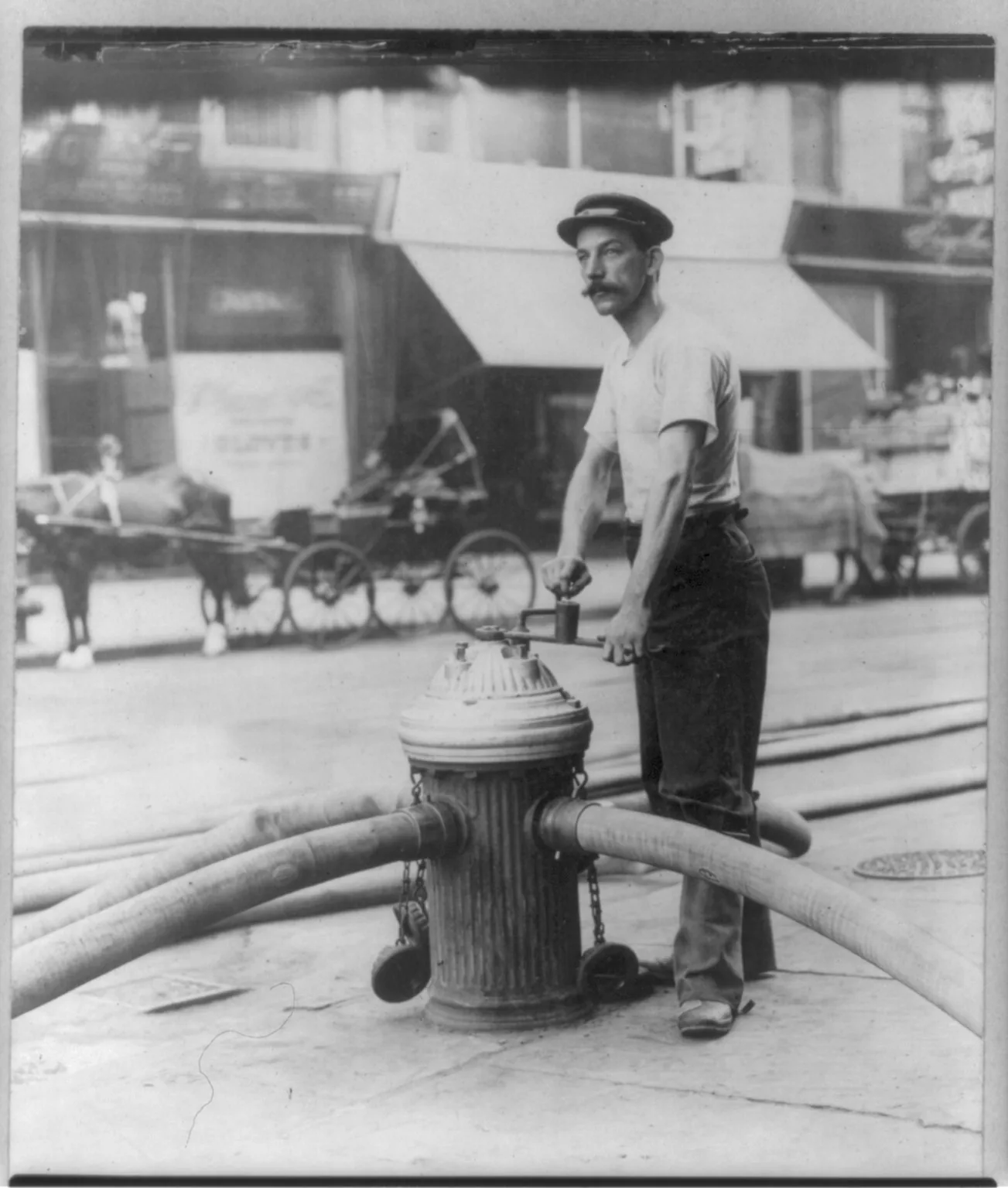
Tall buildings outgrew that system. The New-York Historical Society notes that ordinary pressure could not reach the new skyscrapers. Between 1903 and 1908 four high-pressure pumping stations were built, two in Brooklyn and two in Manhattan. On an alarm they raised the pressure threefold or more and sent the water through high-pressure mains to hydrants. The Gansevoort Street station had five pumps, each able to deliver 2,700 gallons (10,200 liters) a minute, and it was called into action at the Triangle Factory fire.
A DEP archive drawing dated February 19, 1905, shows one of those hydrants. According to DEP, high-pressure hydrants had nozzles for four hoses and could take far more pressure than the “low pressure” hydrants on the regular system.
Where to see one
On the street, in all five boroughs. DEP’s hydrant dataset on NYC Open Data lists 109,725 hydrants, each with a unit ID, a borough and a latitude and longitude.
The New-York Historical Society holds a cast-iron one, made by the Kennedy Valve Manufacturing Company in New York. It is painted red, and “KENNEDY VALVE MFG CO/ NEW YORK” is cast around the lid. The society also holds hydrant wrenches dated between about 1840 and 1925, and a 1999 pastel, Portrait of a Fire Hydrant, Gramercy Park, New York. The pastel shows a black hydrant with a yellow top on the southwest side of Gramercy Park, at 20th Street and Irving Place. The catalog records are online.
The song
The Hydrant
Jersey club · salsa · 2:30
On the map
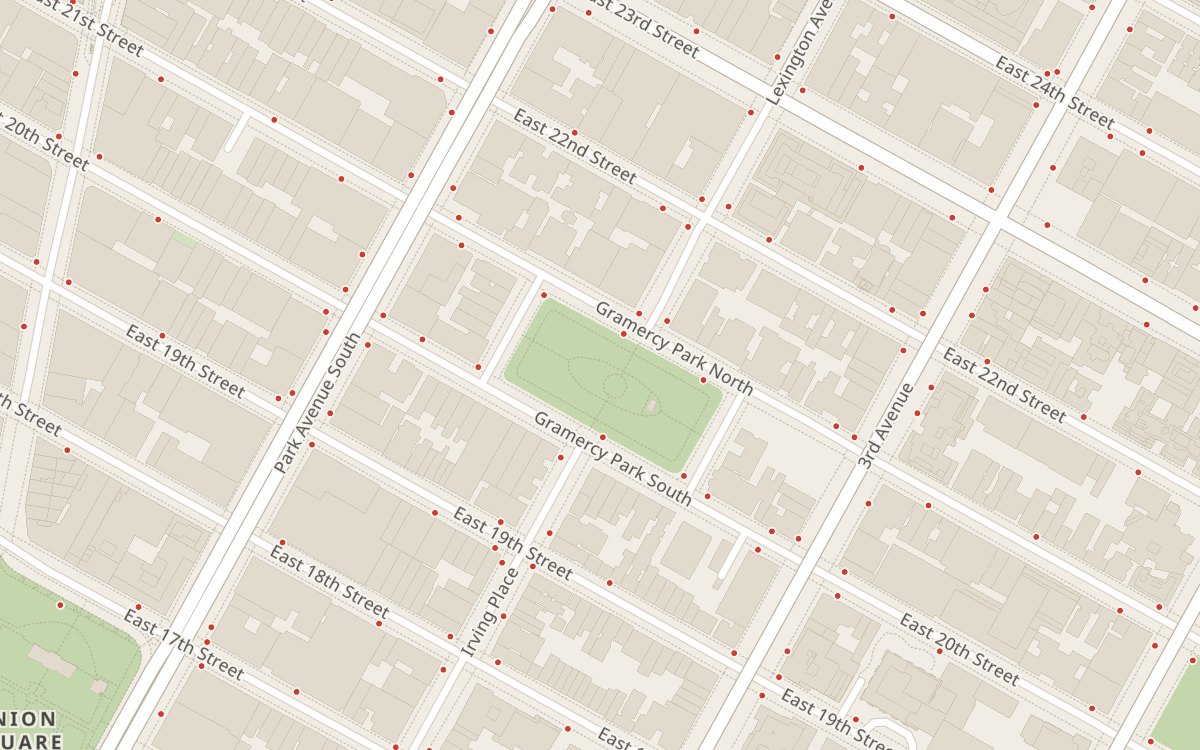
Gramercy Park, 20th Street and Irving Place, Manhattan. Open The Atlas →
Map: OpenFreeMap · © OpenStreetMap contributors
In the collection
 New York № 001 The Hydrant Cast iron at the curb. Built to the city’s specification. See The Hydrant →
Sources
- NYC DEP Standard Sewer and Water Main Specifications (8/8/2022), Section 20.08 — NYC Department of Environmental Protection / Department of Design and Construction
- Specification Bulletin SB 21-002: Hydrants — NYC Department of Design and Construction
- Audit Report on the Department of Environmental Protection's Handling of Fire Hydrant Inspections and Repairs — Office of the New York City Comptroller
- Local Law No. 112 of 2018 (Administrative Code § 15-134) — New York City Council
- Rules of the City of New York, Title 15, Chapter 20: Rules Governing and Restricting the Use and Supply of Water — NYC Department of Environmental Protection
- DEP Issues Safety Alert on Opening Fire Hydrants (June 8, 2011) — NYC Department of Environmental Protection
- DEP Kicks Off 2011 Summer Fire Hydrant Abuse Prevention Campaign (July 14, 2011) — NYC Department of Environmental Protection
- DEP Encourages Safe Hydrant Use to Safeguard Water Pressure During Historic Extreme Heatwave (July 2, 2026) — NYC Department of Environmental Protection
- Fire Hydrant Request — NYC311
- Parking Regulations — NYC Department of Transportation
- In new PSA, the FDNY reminds New Yorkers to never block fire hydrants — FDNY
- History of New York City's Drinking Water — NYC Department of Environmental Protection
- How New York City Found Clean Water — Smithsonian Magazine
- New York's Bravest: Firefighting in NYC, circa 1900 — New-York Historical Society
- High Pressure Fire Hydrant Drawing (Out of the Archives) — NYC Department of Environmental Protection (NYC Water)
- Hydrants (NYCDEP Citywide Hydrants) — NYC Open Data, Department of Environmental Protection
- Fire hydrant, Kennedy Valve Manufacturing Co. (INV.54) — New-York Historical Society
- Hydrant wrench (INV.9014) — New-York Historical Society
- Portrait of a Fire Hydrant, Gramercy Park, New York (2002.28) — New-York Historical Society
Images
- Opening photograph: Phil Roeder, CC BY 2.0, via Wikimedia Commons
- A black fire hydrant with a silver bonnet standing on wood chips under trees in Central Park.: Tony Hisgett, CC BY 2.0, via Wikimedia Commons
- A fireman in a cap works a wrench on a hydrant fitted with hoses, a horse and carriage behind him.: George Grantham Bain Collection (Library of Congress), Public domain, via Wikimedia Commons


