New York · Journal
It's Brick: The New York Word for Freezing Cold
In New York, brick means very cold. What Merriam-Webster, the OED and Green's record about the word, and what a Central Park winter brings.

In New York, the coldest days of the year can be summed up in two words: it’s brick. The word is an adjective, it means very cold, and it comes from African American English as spoken in New York City. It has been in print since the 1990s.
What the dictionaries say
Merriam-Webster lists brick as a slang adjective meaning “extremely cold (used of weather).” The Oxford English Dictionary added it in June 2019, defined as “Of conditions or the weather: very cold, freezing. Also occasionally of a person.” Green’s Dictionary of Slang gives it as “of weather, cold.”

It works like other weather adjectives: it’s brick, it’s brick outside, it’s brick out there. One of Merriam-Webster’s examples comes from Tamron Hall, speaking on ABC in January 2024: “Let me tell you something, it’s brick out there. It is brick. It is so cold.”
New York speech often adds an intensifier. In mad brick, mad carries the informal sense Merriam-Webster defines as “very, extremely,” and Green’s cites The New York Times in January 2012 with “mad brick out.” Dumb brick works the same way. When a caller from Brooklyn asked about it on the language radio show A Way with Words in 2019, the show noted that dumb used this way “has been documented since the 1700s.”
Where it comes from
Merriam-Webster names the source: “The slang use of brick by itself to mean ‘cold/frigid/freezing’ originated in African American English as used in New York City and its environs.” Green’s Dictionary of Slang labels the word “US black.”
The OED also records brick-cold, with the same meaning, and its earliest evidence for that form is from 1995, in the New York Daily News. Its earliest evidence for brick on its own is from 1999. The dictionary treats the short form as a clipping of brick-cold.
The comparison underneath is older than the slang. Merriam-Webster notes that “the coldness of bricks, especially in the winter, has long been noted,” and cites “As cold as a brick” from a Knoxville, Tennessee, newspaper in 1994. What is new is brick standing alone as the adjective.
In print, and beyond the city
The earliest citation in Green’s comes from Paul Beatty’s 2000 novel Tuff, about a man from East Harlem who runs for City Council: “Yo, it’s brick out there today. Cold as hell.” Merriam-Webster cites VIBE in December 2005: “the tropics are definitely the place to be when it’s brick outside.”
In 2023, Danah Abdulaziz opened an opinion piece in City Limits by setting out what makes her a New Yorker. She grew up in Brooklyn in the late 1990s and early 2000s, she wrote, and “I know not to eat pizza with a fork.” Two sentences later: “I say things like, ‘it’s brick outside,’ when it’s freezing.”
Yo, it's brick out there today. Cold as hell.
The word has not stayed entirely at home. Merriam-Webster says it “is still used primarily in New York, but is starting to spread to other locales.” Green’s includes a 2016 citation from the campus slang lists of the linguist Connie Eble at the University of North Carolina at Chapel Hill, compiled each year from slang terms her students submitted on index cards. A Way with Words describes brick as having “meant ‘cold’ for decades,” still “strongly associated with the city,” and a word that “isn’t really associated with one particular generation.”
How cold is brick
None of the dictionaries ties the word to a number. The National Weather Service has the numbers. Its record for Central Park begins in 1869, and observations there have been taken at Belvedere Castle since 1920.
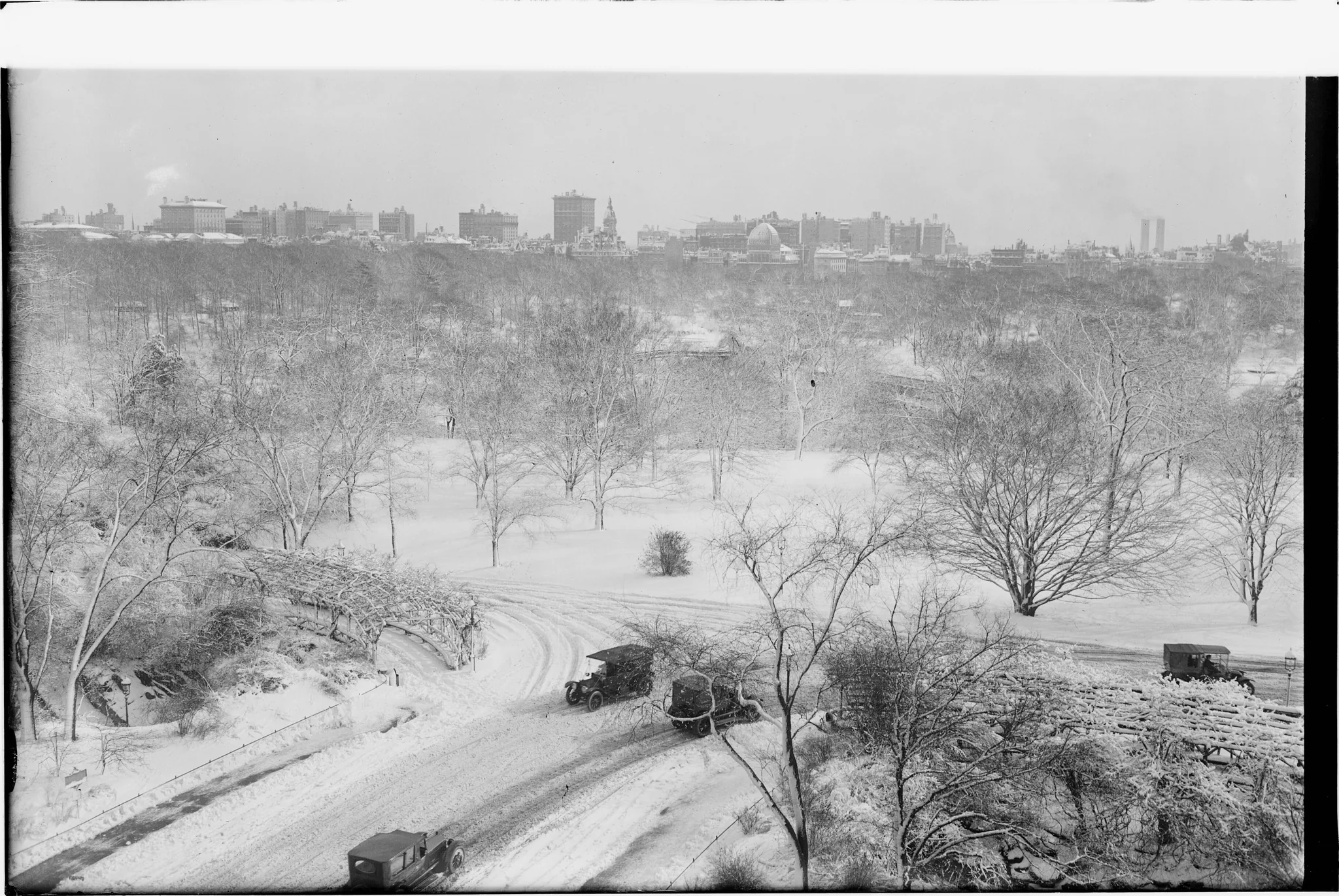
Under the 1991–2020 normals, January is the park’s coldest month, with an average high of 39.5°F (4.2°C), an average low of 27.9°F (-2.3°C) and a monthly mean of 33.7°F (0.9°C). The coldest January on record, in 1918, averaged 21.7°F (-5.7°C).
The extremes sit well below that. The lowest temperature on record in Central Park is -15°F (-26.1°C), on February 9, 1934, and February 1934 remains the coldest month on record, at an average of 19.9°F (-6.7°C). The last time the park fell below zero was February 14, 2016, when it reached -1°F (-18.3°C).
The song
It’s Brick
Brooklyn drill · 2:30
In the collection
 New York It’s Brick It’s brick. Two words for the cold. See It’s Brick →
Sources
- Brick Slang Meaning — Merriam-Webster
- Mad Definition & Meaning — Merriam-Webster
- June 2019 update — Oxford English Dictionary
- brick, adj.² — Oxford English Dictionary
- brick-cold, adj. — Oxford English Dictionary
- brick, adj. — Green's Dictionary of Slang
- “Dumb Brick” Means Very Cold in New York City Slang — A Way with Words
- Opinion: I'm a New Yorker. I'm Also 'Stateless.' It's Time for the U.S. to Help People Like Me — City Limits
- Tuff by Paul Beatty — Kirkus Reviews
- Connie Eble Papers, 1972-2019 — UNC Chapel Hill University Library
- Central Park, NY Historical Data — National Weather Service
- Normals and Extremes, Central Park, NY — National Weather Service
- All-Time Extremes, Central Park, NY — National Weather Service
- Below 0 Degree Day Facts for Central Park — National Weather Service
Images
- Opening photograph: Anthony Quintano, CC BY 2.0, via Wikimedia Commons
- Black-and-white view over a snow-covered Central Park, with a road and vehicles in the foreground and the city beyond.: Bain News Service (Library of Congress), Public domain, via Wikimedia Commons

