New York · Journal
What 'Aight, so boom' means, word by word
Aight, so and boom each have a documented job in American speech. What the OED, Green's Dictionary of Slang and linguists record about each.

The line on this shirt is three short words and an ellipsis: Aight, so boom… Each of the three words has a record in dictionaries and in research on how people talk.
Aight in the dictionaries
The Oxford English Dictionary first published an entry for aight, as an adjective and interjection, in September 2012. It treats the word as a variant of all right and notes that it “is used in U.S. English.” The OED’s earliest evidence is from 1993, in Vibe. It gives two American pronunciations, spelled out as “ah-IGHT” and “ight,” and records how rarely the word reaches print: “Fewer than 0.01 occurrences per million words in modern written English.”
Green’s Dictionary of Slang files the word under a-ight, with the spellings ai-ight, aiite, ight and iight. It explains the form as an elision of standard English all right and labels it US Black and campus slang. Its quotations open with a 1942 item in the New York People’s Voice, which spells a related form “aw-reet.” The modern shape appears in The Source in August 1994: “Y’ all a-ight?” Later quotations include a line from the first episode of The Wire, in 2002.

Collins English Dictionary defines aight as “an informal or dialect word for all right.”
An old job for "all right"
Aight carries the uses of all right, and Merriam-Webster is specific about one of them. As an adverb, all right is “used interjectionally especially to express agreement or resignation or to indicate the resumption of a discussion.” The dictionary dates that interjection use to the 15th century. Cambridge gives the plain sense of agreement: “used to show that something is agreed, understood, or acceptable.”
So the first word on the shirt does two things at once: it accepts what came before and signals that the talk is starting again.
"So" as a way back into a story
So has its own documented role at the front of a sentence. Merriam-Webster lists it as “an introductory particle,” with the example “so here we are.” Cambridge describes it as “used at the beginning of a sentence to connect it with something that has been said or has happened previously,” and its example is a story in progress: “So, there I was standing at the edge of the road with only my underwear on …”
Linguists have studied this use closely. In a 2009 article in the Journal of Pragmatics, Galina Bolden of Rutgers University examined a large corpus of recorded conversations and found that so is “recurrently used in contexts where the activity being launched has been relevantly pending.” In storytelling, she writes, so marks “a resumption of the telling after an interruption,” and signals that what follows is “advancing the main story line” rather than more background.
"Boom" and the sudden turn
Boom started as a sound. Merriam-Webster traces the verb to Middle English and calls it “of imitative origin.” The noun, meaning a booming sound, is “often used interjectionally to indicate suddenness,” as in the dictionary’s example: “Then boom, he was fired.”
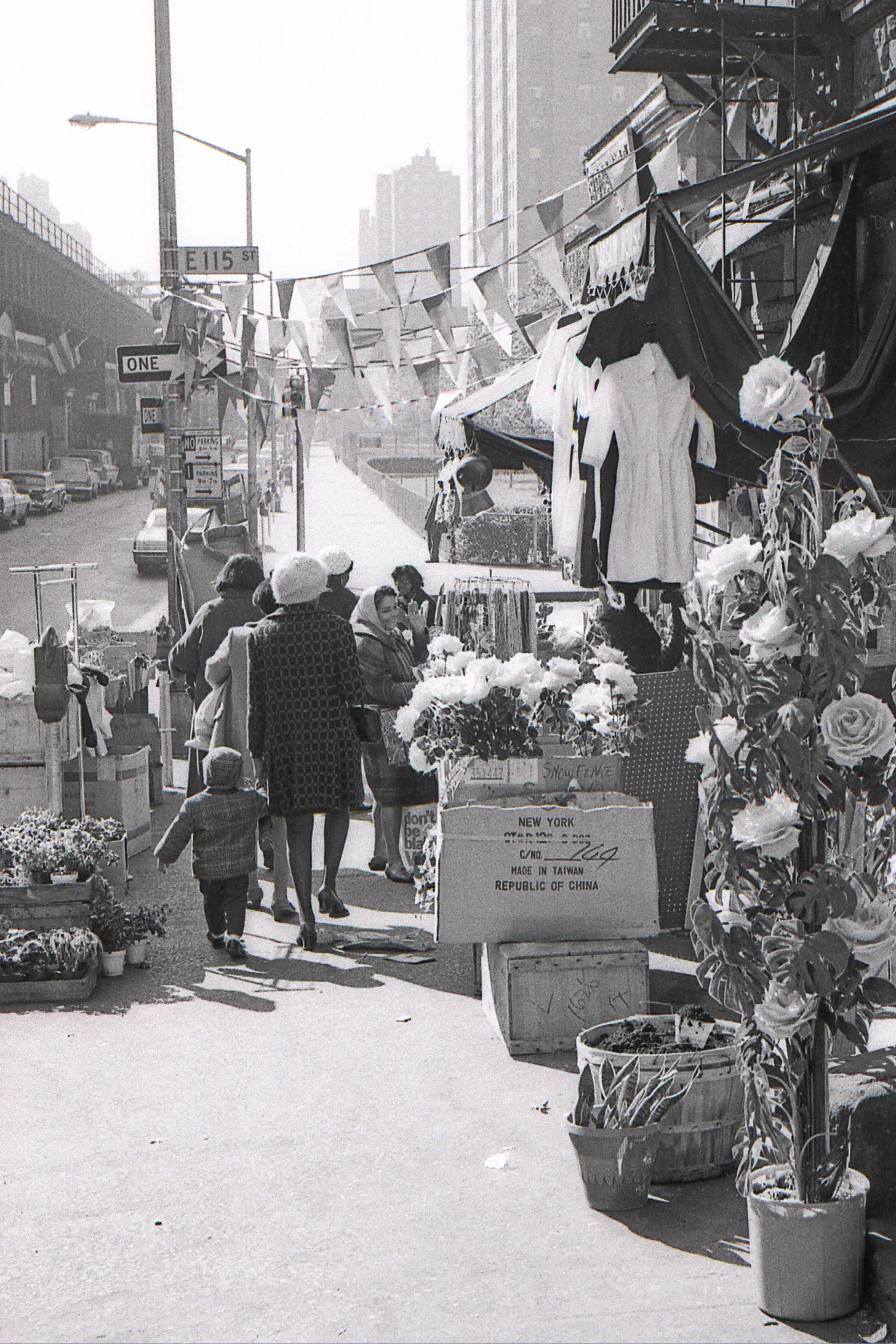
Green’s records the same exclamation, “used to imply suddenness, of a statement, an action etc.,” with quotations from 1945 on. One comes from Philippe Bourgois’s In Search of Respect, an ethnography of East Harlem, the neighborhood also called El Barrio, first published in 1995. The book’s subjects are Puerto Rican New Yorkers. The line Green’s quotes from it: “Everytime they sent me to some company, boom! I’m hired.” Green’s also lists a second, US Black sense of boom, “a general excl. of agreement,” citing Juba to Jive (1994).
A New York way of studying stories
The study of how people tell stories has New York roots. William Labov wrote that the narrative analysis he developed with Joshua Waletzky was “a by-product” of field methods from his survey of the Lower East Side and from “the study of African American Vernacular English in South Harlem.” His 1972 book Language in the Inner City: Studies in the Black English Vernacular reports that work, carried out with the linguist Paul Cohen and two Black researchers, Clarence Robins and John Lewis. Its third part includes a study of personal narrative.
Everytime they sent me to some company, boom! I'm hired.
Labov’s framework names the parts of a story. A clause of complicating action “reports a next event in response to a potential question, ‘And what happened [then]?’” He also writes that “a narrative of personal experience is essentially a narrative of the most reportable event in it.”
Read against that vocabulary, the printed line is a small story in three words: aight agrees and restarts the talk, so points back to the main line, and boom is the next event arriving all at once.
The song
Aight, So Boom…
Vogue house · 2:29
In the collection
 New York Aight, So Boom Three words. A story about to start. See Aight, So Boom →
Sources
- aight, adj. & int. — Oxford English Dictionary
- a-ight, phr. — Green's Dictionary of Slang
- boom!, excl. — Green's Dictionary of Slang
- AIGHT definition — Collins English Dictionary
- all right — Merriam-Webster
- all right — Cambridge Dictionary
- so — Merriam-Webster
- so — Cambridge Dictionary
- boom — Merriam-Webster
- Implementing incipient actions: The discourse marker 'so' in English conversation — Galina B. Bolden, Journal of Pragmatics (2009)
- In Search of Respect — Cambridge University Press
- Introduction — In Search of Respect, Cambridge University Press
- A Street History of El Barrio — In Search of Respect, Cambridge University Press
- Some Further Steps in Narrative Analysis — William Labov, University of Pennsylvania
- Language in the Inner City: Studies in the Black English Vernacular — ERIC
Images
- Opening photograph: Gryffindor, CC BY-SA 3.0, via Wikimedia Commons
- Black-and-white street scene in East Harlem, 1969: shoppers on a sidewalk lined with flower and clothing stalls, pennants strung over the street, a street sign reading E 115 St.: Hartmut Schmidt Heidelberg, CC BY-SA 4.0, via Wikimedia Commons

