New York · Journal
Why New York Buildings Have Wooden Water Tanks on the Roof
City water pressure reaches about the sixth floor. Above that, New York buildings pump water into wooden rooftop tanks built much as they were a century ago.

Wooden tanks on steel frames stand on the roofs of New York apartment buildings, hotels and office towers. They look old, and they are working plumbing. The city Health Department says water tanks help deliver drinking water to millions of New Yorkers.
The sixth-floor limit
New York’s water flows to the city from upstate reservoirs, and in most of the city it is delivered by gravity alone. The pressure in the mains lifts it to about the sixth floor of most buildings. Anything taller has to raise its own supply.
The method New York settled on in the late 1800s is still in use. A pump sends water to a tank on the roof, and gravity takes it back down to the taps. The Department of Environmental Protection says water must be pumped and stored in rooftop tanks to serve buildings with more than six floors, and that once it is up there, gravity supplies the pressure for the shower and the sink. The pump does not run all day. It switches on when the level in the tank drops.

The water inside is divided by height. A pipe about halfway down feeds the building. A pipe near the bottom serves the sprinklers and the firefighting system, so the lowest water is held in reserve for a fire.
A barrel on the roof
The New York Times has called these tanks giant wooden barrels, and their basic design has changed little in more than a century. The walls are upright boards, or staves, of redwood or cedar. They are cut in a shop to fit the particular building, lifted to the roof by crane and hoist, and assembled there. Bands of galvanized iron or cable hold them together.
The city Housing Authority notes that no glue, nails or screws are needed. No sealant is used either. When a new tank is first filled, water leaks through every gap. As the wood soaks up water, it swells and the gaps close. An Isseks Brothers crew that Agence France-Presse followed in 2018 expected its Alaskan cedar to take two or three days to become watertight. Scott Hochhauser of Isseks explained it in 1989: “With the hoops pressing in and the water pressing out, it makes it watertight.”
With the hoops pressing in and the water pressing out, it makes it watertight.
A cone-shaped roof keeps out rain, snow and contaminants, and the air trapped under it adds insulation in winter. Tanks typically hold 5,000 to 10,000 gallons (19,000 to 38,000 liters). Wood insulates well, which keeps the water cool in summer and keeps it from freezing in winter. Steel tanks exist, but they can cost up to four times as much, and they are usually hidden inside enclosures.
A wooden tank lasts about 25 to 30 years. When it comes down, its old boards can end up with furniture makers.
The families who build them
New Yorkers celebrated the opening of the Croton water supply in October 1842. According to Kathleen Hulser, a historian at the New-York Historical Society, indoor plumbing began replacing well water in that decade, and natural pressure could supply every building in the city. The Times reported in 2007 that tanks began appearing about fifty years later, along with the tall buildings. The first tankmen were barrel makers.
By The Times’s count in 2012, three family companies handled most of the installing and replacing: Isseks Brothers, Rosenwach and American Pipe and Tank. Each had run for at least three generations. Isseks dates to 1890, when the Isseks brothers, immigrants from Poland, founded it. A 1989 newspaper account gives 1896 as the year Wally Rosenwach’s grandfather bought the tank company he worked for and gave it his own name. That year the two families still disagreed about who came first. “This whole bit about when who started what business is silly,” said Wally Rosenwach, then the company’s chairman. American Pipe and Tank came to wooden tanks later. In 2012 it had been in the business for about thirty years.
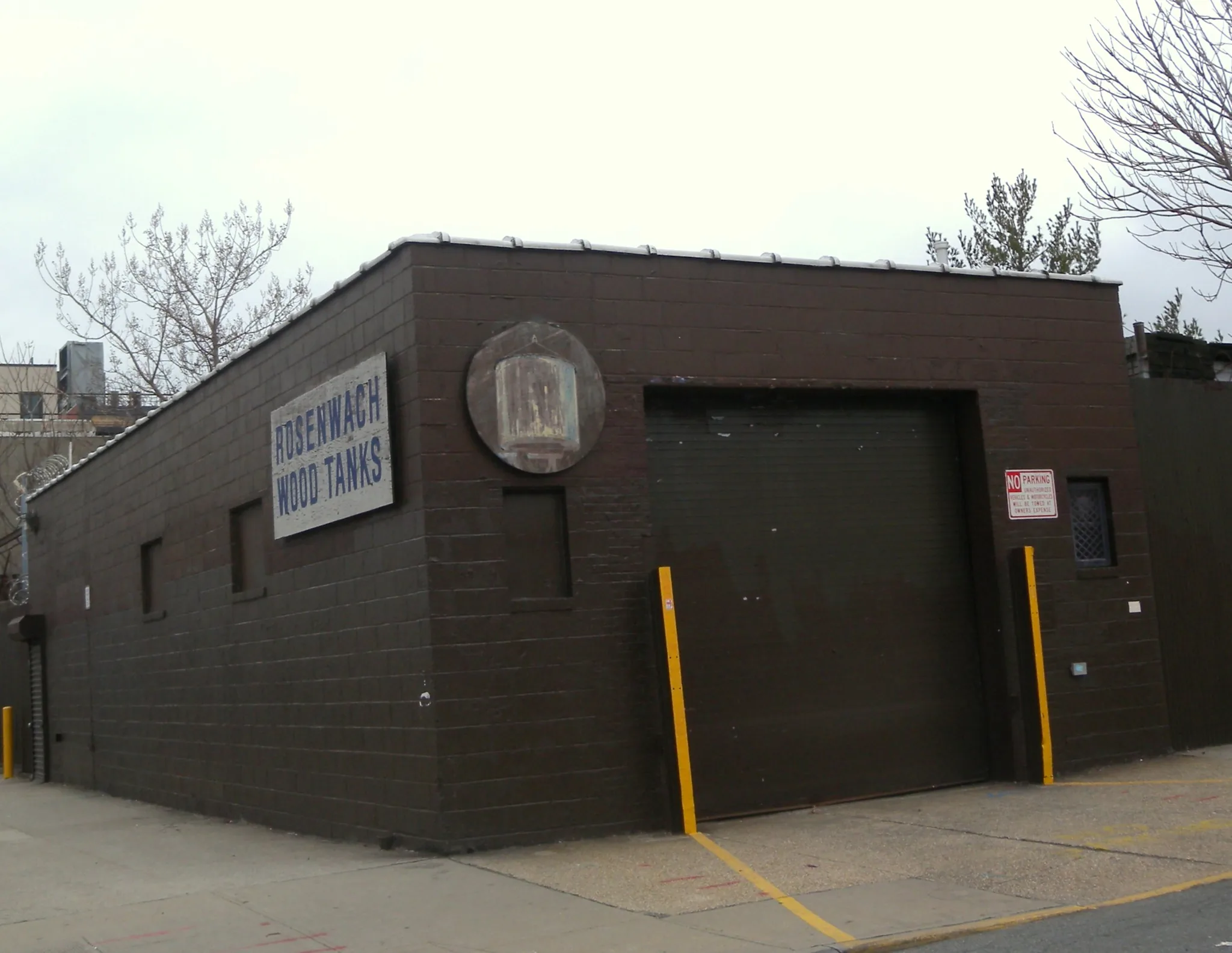
In 2018 the boards for Isseks tanks came from the Hall-Woolford Wood Tank Company in Philadelphia. AFP reported that its workshop had seven employees and that nothing there was automated.
The work on the roof has barely changed. David Hochhauser, who owns Isseks with his brother and sister, told The Times in 2012 that a century had brought little more than power tools. For a 2007 story, The Times watched a Rosenwach crew put up the body of a tank on a 24-story hotel near the Empire State Building in under two hours, setting the boards with a hammer and a rope. In 2018 an Isseks crew led by Terrance Stokes, who had followed his father into the trade, replaced a tank on Lexington Avenue in about seven hours. Water was flowing into the new one by 3 p.m.
In 2001 the Smithsonian invited Andrew Rosenwach, the fourth-generation owner of his family’s company, and his workmen to build a New York water tower in the center of the National Mall for its Folklife Festival. The program lists five water tank builders: William Bush, Adonis Cegisman, Ryszard Danielewski, John DeGeorge and Rosenwach himself.
Who checks the water
Because the tanks hold drinking water, the city Health Code covers them. Owners must have each tank inspected at least once a year, with a bacteriological water sample. The inspector must be a licensed master plumber, someone working under one, or a licensed engineer or architect. The report is due to the Health Department by January 15 of the following year. Owners must post signs telling residents how to see the results, and keep the records for at least five years.
The yearly water test came much later. It was first required by a City Council law that grew out of a 2009 bill, which also made owners show inspection records to tenants. In 2014 a New York Times investigation reported that the city’s own surveys suggested nearly 60 percent of owners did not comply. City officials could not say for sure how many tanks were in use.
Where to see them
From the roof of that hotel near the Empire State Building, the Times reporter could see 150 wooden tanks. The paper illustrated its 2014 investigation with a SoHo skyline dotted with water towers. New buildings use them too. In 2012 David Hochhauser pointed to the condominiums at 15 Central Park West as one of the new luxury buildings with wooden tanks.
The inside of one tank can be seen at the Museum of Modern Art. In 1998 the Public Art Fund commissioned the British artist Rachel Whiteread to cast the interior of a cedar tank in translucent resin. The cast, 12 feet 2 inches (3.7 m) high and 9 feet (2.7 m) across, was raised seven stories onto a steel tower frame at West Broadway and Grand Street in SoHo. In bright sun it glowed, and at night it disappeared against the sky. It is now in the museum’s collection and stands in its Sculpture Garden.
For a particular building, the Health Department’s website lists its self-reported inspection filings, searchable by street address or building identification number. The results show how many tanks the building has.
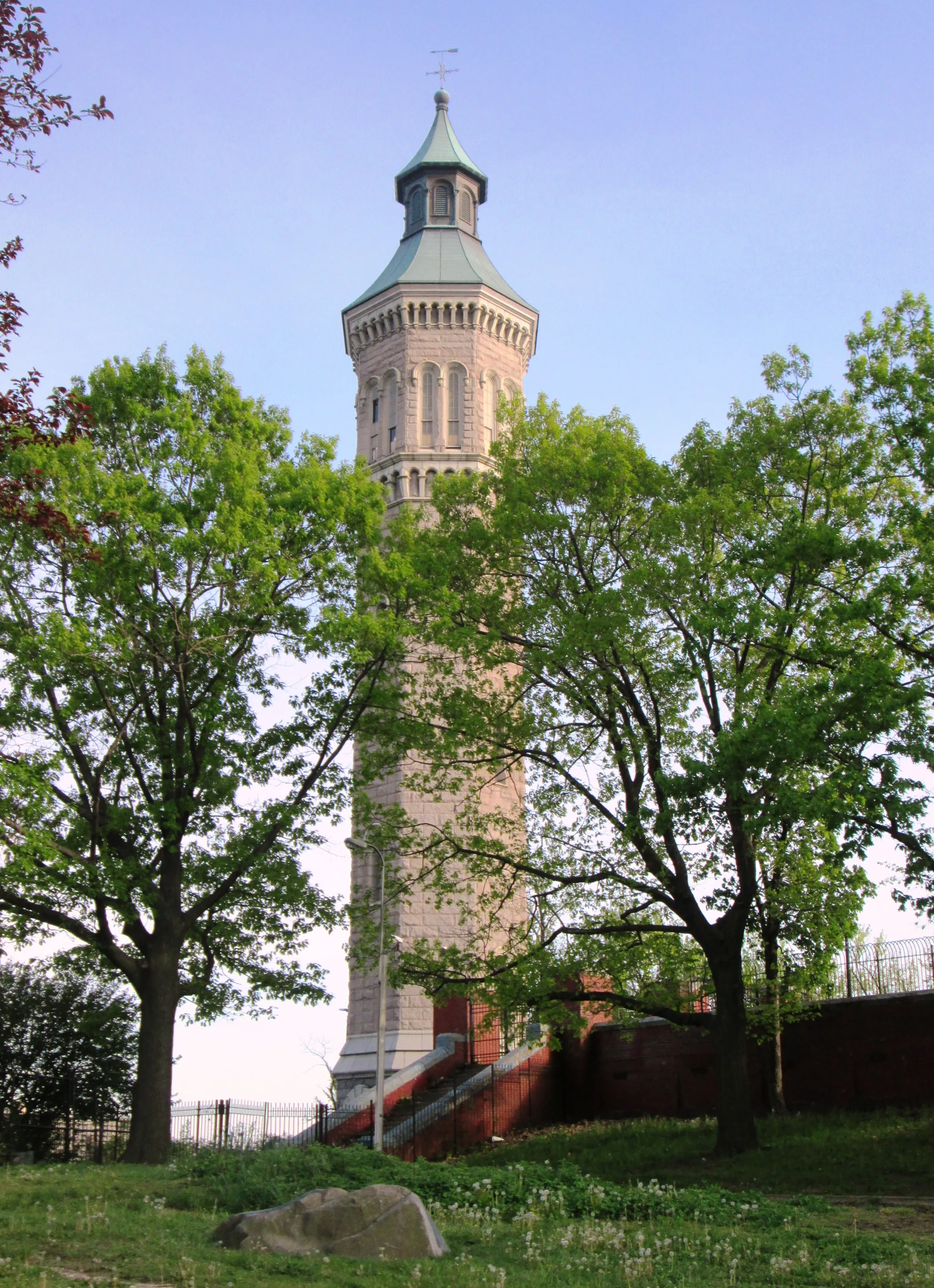
In Highbridge Park, opposite Amsterdam Avenue at West 173rd Street, stands the city’s own answer to the same problem. The stone Water Tower there was built in 1872 as part of the Croton system. It served as a booster tower, supplying water pressure to the neighborhood and as far south as Murray Hill, and it was built to carry a standpipe and an iron tank holding 47,000 gallons (178,000 liters). The Landmarks Preservation Commission designated it a landmark in 1967.
The song
Cedar on the Roof
Lo-fi soul · boom-bap · 2:53
On the map

SoHo rooftops, Manhattan. Open The Atlas →
Map: OpenFreeMap · © OpenStreetMap contributors
In the collection
 New York № 001 The Water Tower A wooden barrel on the roof. No glue between the staves. See The Water Tower →
Sources
- Understanding NYC's Water Story, Thematic Unit 2: Drinking Water and You — NYC Department of Environmental Protection
- Drinking Water Tank Inspection Reporting — NYC Department of Health and Mental Hygiene
- Rooftop Drinking Water Tank Inspection Results — NYC Department of Health and Mental Hygiene
- NYCHA Capital Projects Fact Sheet: Roof Tank Replacements — New York City Housing Authority
- Water Tower, High Bridge Park, Designation Report LP-0319 — NYC Landmarks Preservation Commission
- Inside City's Water Tanks, Layers of Neglect — The New York Times
- For 3 Families, Wooden Water Tanks Are in the Blood — The New York Times
- Longtime Emblems of City Roofs, Still Going Strong — The New York Times
- On Rooftops, Progress Just Doesn't Hold Water — Deseret News
- On New York's rooftops, old-style wooden water tanks hang tough — AFP (via Malay Mail)
- 2001 Smithsonian Folklife Festival Program Book — Smithsonian Center for Folklife and Cultural Heritage
- Rachel Whiteread, Water Tower, 1998 — The Museum of Modern Art
- Rachel Whiteread: Water Tower — Public Art Fund
Images
- Opening photograph: Frank Schulenburg, CC BY-SA 4.0 (adapted), via Wikimedia Commons
- The brick Rosenwach Wood Tanks workshop on a corner in Williamsburg, Brooklyn, with its painted sign and a roll-up door.: Jim.henderson, CC0, via Wikimedia Commons
- The octagonal stone High Bridge Water Tower rising above trees in Highbridge Park.: Beyond My Ken, CC BY-SA 4.0, via Wikimedia Commons


