New York · Journal
Why Steam Comes Out of New York City Streets
The steam rising from Manhattan streets comes from Con Edison's 105-mile steam system. The orange-and-white stacks carry it above people and traffic.

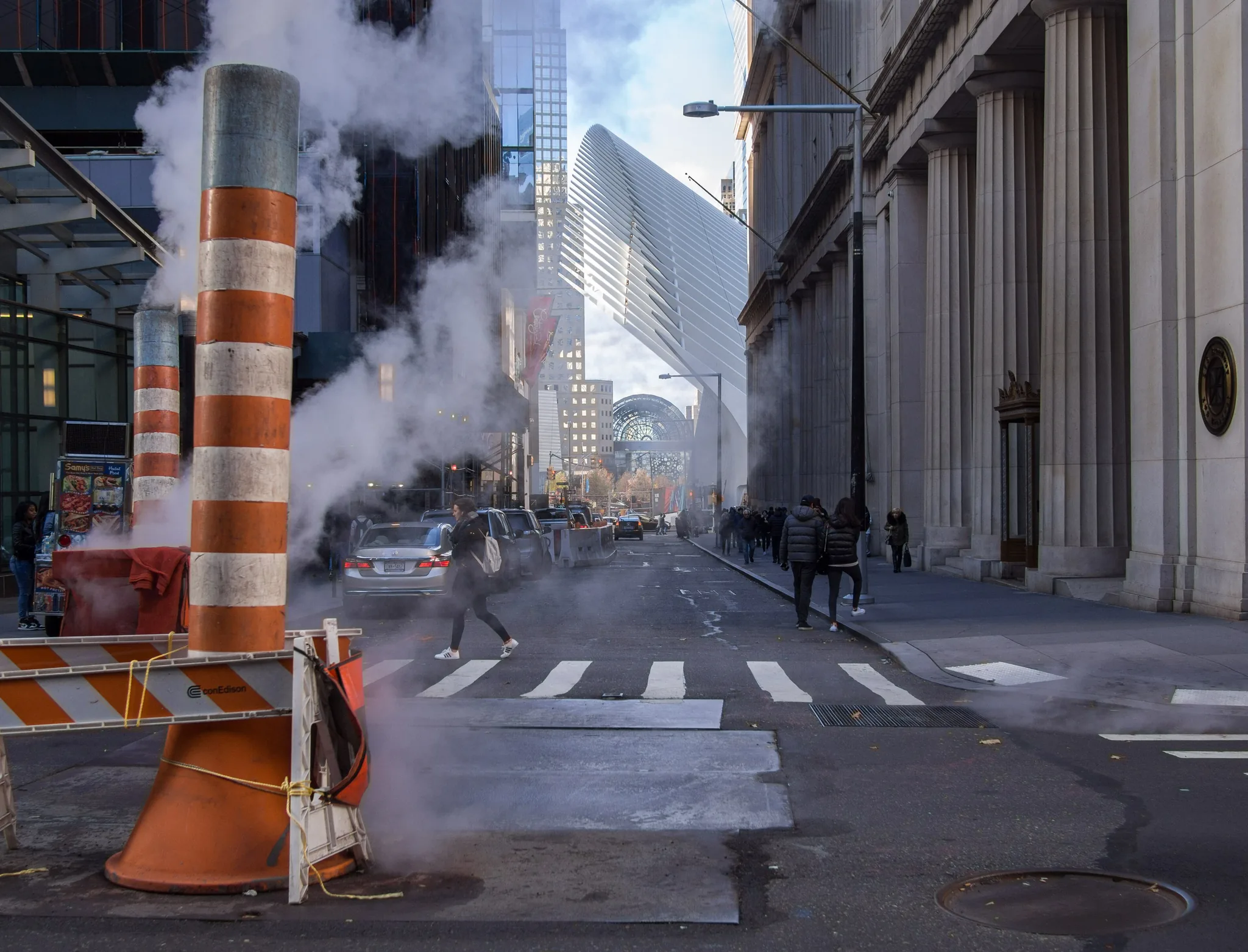
In Manhattan, an orange-and-white striped tube sometimes stands in the street with steam pouring out of its top. Con Edison calls it a stack. It marks a place where water or a leak has met the steam pipes that run under the island.
The stack
A stack is a plastic tube about 10 feet (3 m) tall, either solid orange or striped. Con Edison crews set one over a manhole where steam is rising. It works like a chimney, carrying the hot vapor up and away from people and traffic. The utility gives two reasons for it: so no one touches the vapor and gets burned, and so drivers can still see the road.
Con Edison places a stack when it knows about a controllable steam leak or an underground water leak, has found no immediate safety concern and has begun to schedule a repair. The repairs usually happen overnight.
Filmmakers use the plume as shorthand for New York. Martin Scorsese caught the fog of a steam leak in the opening scene of “Taxi Driver,” and Woody Allen put a stack rising from Fifth Avenue into the opening montage of “Manhattan.” Frank Cuomo, Con Edison’s general manager of steam services, told The New York Times in 2024 that movie producers ask to rent or buy the stacks.
Why the street steams
Con Edison says there is no “natural” venting process. The most common cause of street steam is water. It seeps into a manhole, often after heavy rain, touches a hot steam main and turns to vapor. The other cause is a leak, inside the manhole or in buried pipe between manholes.
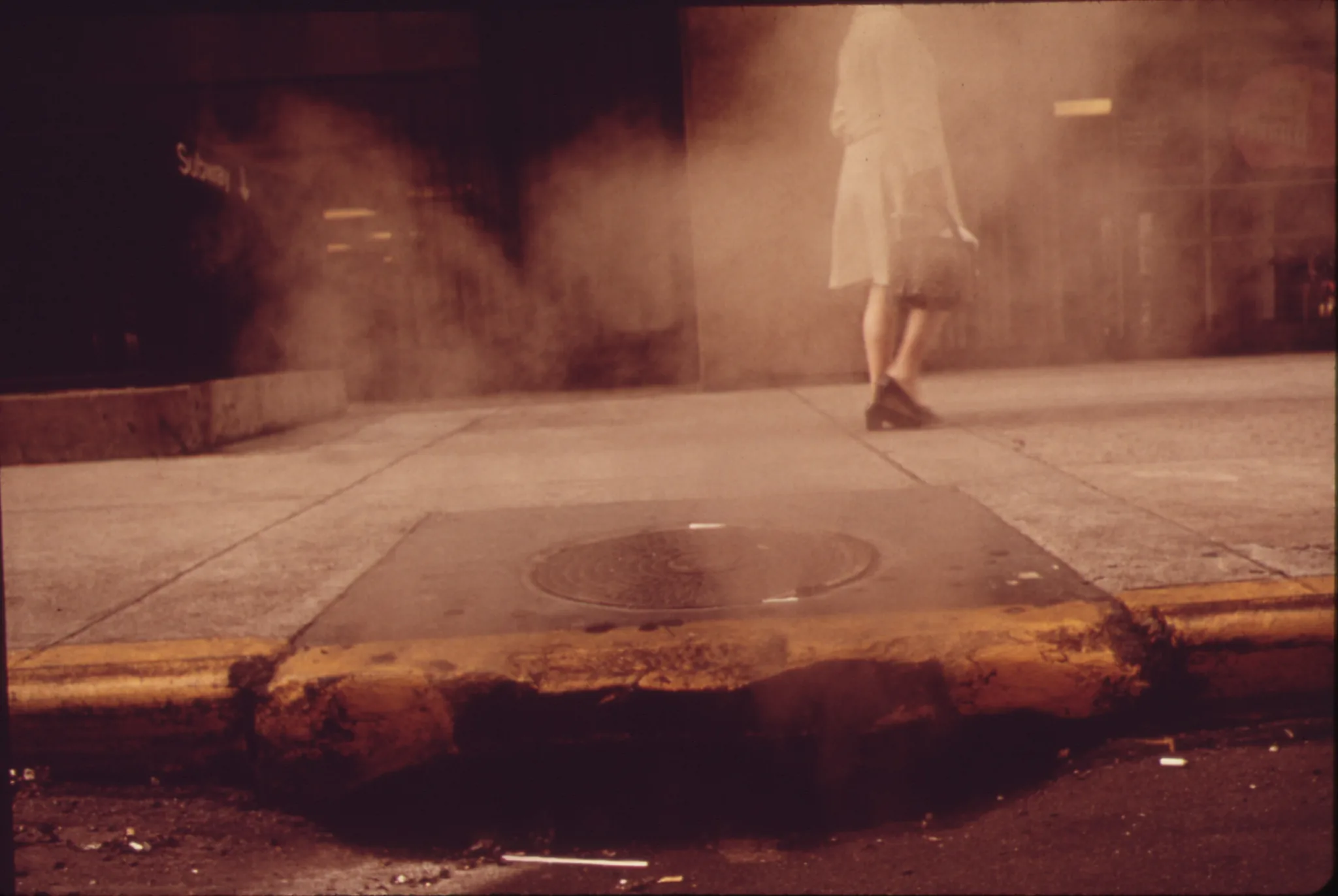
Water is also what threatens the pipes. As steam cools inside the pipes, it turns back into liquid, called condensate. Automatic valves called traps sit at the low points of the system to drain it, and the condensate goes to cooling chambers and then to the city sewers. If the traps fail and water collects in a pipe, the results can be violent.
The pipes under Manhattan
The steam comes from six plants: four in Manhattan, one in Brooklyn and one in Queens. The main source is Con Edison’s plant at the end of East 14th Street, near the East River, which has been in use since 1926 and originally burned coal. The boilers take in city water and heat the steam to more than 400 degrees Fahrenheit (204°C). When it reaches a customer, Con Edison says, it is at about 165 pounds per square inch (1,140 kPa) and 358 degrees (181°C). About 60 percent of the steam comes from cogeneration, which uses heat left over from making electricity.
Con Edison runs 105 miles (169 km) of steam mains and serves more than 1,500 buildings between the southern tip of Manhattan and 96th Street. Buildings use the steam for heat, hot water and air conditioning. Hospitals sterilize equipment with it. Dry cleaners press clothes, restaurants wash dishes, and museums use it for climate control around their art. Grand Central Terminal, the Empire State Building, the United Nations, the Chrysler Building and Madison Square Garden are all customers.
How it began
District steam started upstate. In 1877 Birdsill Holly of Lockport, New York, built a system in which a central boiler plant sent steam through insulated mains to a group of buildings, and each customer paid for the steam used, measured by metering the condensed water. The American Society of Mechanical Engineers marks Lockport as the site of the first district steam heating system in the United States.
Wallace C. Andrews brought the idea to New York. He acquired rights to Holly’s system, and in 1881 his companies were consolidated under the name New York Steam Company. Its first chief engineer, Charles E. Emery, had been a marine engineer during the Civil War. Emery and Andrews divided the city into ten heating districts. The first boiler plant, at Cortlandt, Dey, Greenwich and Washington Streets, was finished in 1881 with 48 boilers and a 225-foot (69 m) chimney. Scientific American put the project on its cover that November.
On March 3, 1882, New York Steam delivered steam to its first customer, the United Bank Building at 88–92 Broadway, on the corner of Wall Street. It had 62 customers by that December, and 350 customers on five miles (8 km) of mains by 1886. The system ran through the blizzard of March 1888. Andrews died with much of his family in a house fire on April 7, 1899.
By 1932 the company supplied more than 2,500 buildings, and most new skyscrapers went up without smokestacks or heating plants of their own. New York Steam merged into Consolidated Edison on March 8, 1954. Demand for the steam peaked in the 1970s.
When a pipe fails
On July 18, 2007, a 24-inch (61 cm) steam pipe laid in 1924 burst under Lexington Avenue at 41st Street, a block from Grand Central Terminal. One person died and more than 30 were injured. Water inside the pipe caused the rupture, in what Con Edison described as a “bubble-collapse water hammer”: a bubble of steam imploded and two pockets of water slammed into each other. Hugh Grant, who oversees the steam system for Con Edison, told The Times in 2024 that the disaster led the company to adopt technology that monitors conditions inside the pipes. Con Edison says its steam operations keep a 24-hour staff, 365 days a year.
Where to see it
In Manhattan only. Con Edison’s steam service runs from the southern tip of the island to 96th Street on the West Side and 89th Street on the East Side. Some of the steam is made across the East River, but all of it ends up in Manhattan. Cuomo’s rule for moviegoers: a stack in a scene set in Brooklyn or the Bronx has to be a fake.
A stack stays only until the repair is done, so none has a permanent address. The system’s fixed points are easier to find. The main plant stands at the end of East 14th Street by the East River. At the 9/11 Memorial, steam keeps the reflecting pools from freezing. The first boiler plant stood at Cortlandt, Dey, Greenwich and Washington Streets, and the first customer was at Broadway and Wall Street.
If steam is rising from a manhole or a crack in the street with no stack over it, Con Edison asks people to call 1-800-75-CONED (1-800-752-6633).
The song
The City Exhales
Deep house · 3:41
In the collection
 New York № 001 The Steam Stack A striped chimney for the steam beneath the street. See The Steam Stack →
Sources
- Steam Safety — Con Edison
- Steam Operations Knowledge Center: FAQs — Con Edison (archived 2016)
- A Brief History of Con Edison: Steam — Con Edison (archived 2006)
- Con Edison Celebrates 200 Years of Energizing New York — Con Edison
- Con Edison's Steam System Will Become NYC's Hottest New Clean Energy Solution — Con Edison
- Orange Steam Funnels Are a New York Symbol. What Are They For? — The New York Times
- Miles of Steam Pipes Snake Beneath New York — The New York Times
- Asbestos and Aging Pipes Remain Buried Hazards — The New York Times
- Holly District Heating System, Landmark #122 — American Society of Mechanical Engineers
Images
- Opening photograph: MartinThoma, CC0 (adapted), via Wikimedia Commons
- Steam drifting over a sidewalk from a manhole at the curb, with a woman walking past.: Chester Higgins, Jr., Public domain, via Wikimedia Commons
- Two orange-and-white striped steam stacks venting at the corner of Broadway and Dey Street, with the Oculus in the background.: Rhododendrites, CC BY-SA 4.0, via Wikimedia Commons


