New York · Journal
The Brooklyn Bridge Promenade and the Cables Above It
The Brooklyn Bridge promenade runs over the traffic under four steel cables, 1,520 suspenders and 400 diagonal stays. How the web works and who built it.

The Brooklyn Bridge promenade runs down the middle of the bridge, above the car lanes. Over it hang four main cables, 1,520 vertical suspenders and 400 diagonal stays. The walkway has been part of the bridge since it opened on May 24, 1883.
The promenade
The bridge was built to carry walkers, vehicles and cable cars at the same time. The National Park Service’s landmark nomination describes a promenade laid down the center of the 85-foot-wide (26 m) roadway, with the cable cars running beneath it. By 1888 those cars carried more than 30 million passengers a year. Trolleys came later, and after them el trains.
The els stopped running in 1944. In the reconstruction that followed, NYC DOT says, the railroad and trolley tracks came out and the roadways were widened from two lanes to three.
Long stretches of the walk are a wooden deck. NYC DOT says the walkway averages 16 feet (4.9 m) across and varies along its length. A 2016 department study shows it 43 feet (13 m) wide at the towers and 10 feet (3 m) at its narrowest point, at the trunk cable bases. The study noted that the narrow point is also a photo spot.
The 1975 National Register form said that “hundreds of pedestrians” still used the walkway on weekends. In September 2021 the city opened a two-way protected bike lane on the bridge, taking one lane from cars. In January 2024 NYC DOT issued a rule that bars vending on the walkways and bike lanes of city bridges. It reported that the Brooklyn Bridge drew an average of 34,000 pedestrians on a fall weekend day, up from 17,000 in 2021.
The web overhead
Four main cables carry the deck. Each is 15¾ inches (40 cm) thick and holds 5,434 wires, according to both the Park Service nomination and the Historic American Engineering Record, the federal survey of the bridge held at the Library of Congress. The wire was spun in place. An iron wheel fastened to a working rope ran between the anchorages, carrying a loop of wire across the river on each trip, and the wires were gathered into 19 strands for each cable. HAER notes that this was the first time steel wire, galvanized against rust, was used in a bridge.
From the cables hang 1,520 vertical suspenders. The 400 diagonal stays run from the tops of the towers down to points along the deck. They were one of the features John A. Roebling developed over a career of building suspension bridges. HAER describes them as a secondary system that carried part of the deck and steadied the bridge against vertical movement in strong winds. The Park Service nomination says the stays alone were strong enough to hold 15,000 tons (13,600 tonnes), more than the weight of the entire deck. HAER adds that the Roebling system became the standard for suspension bridges throughout the world.
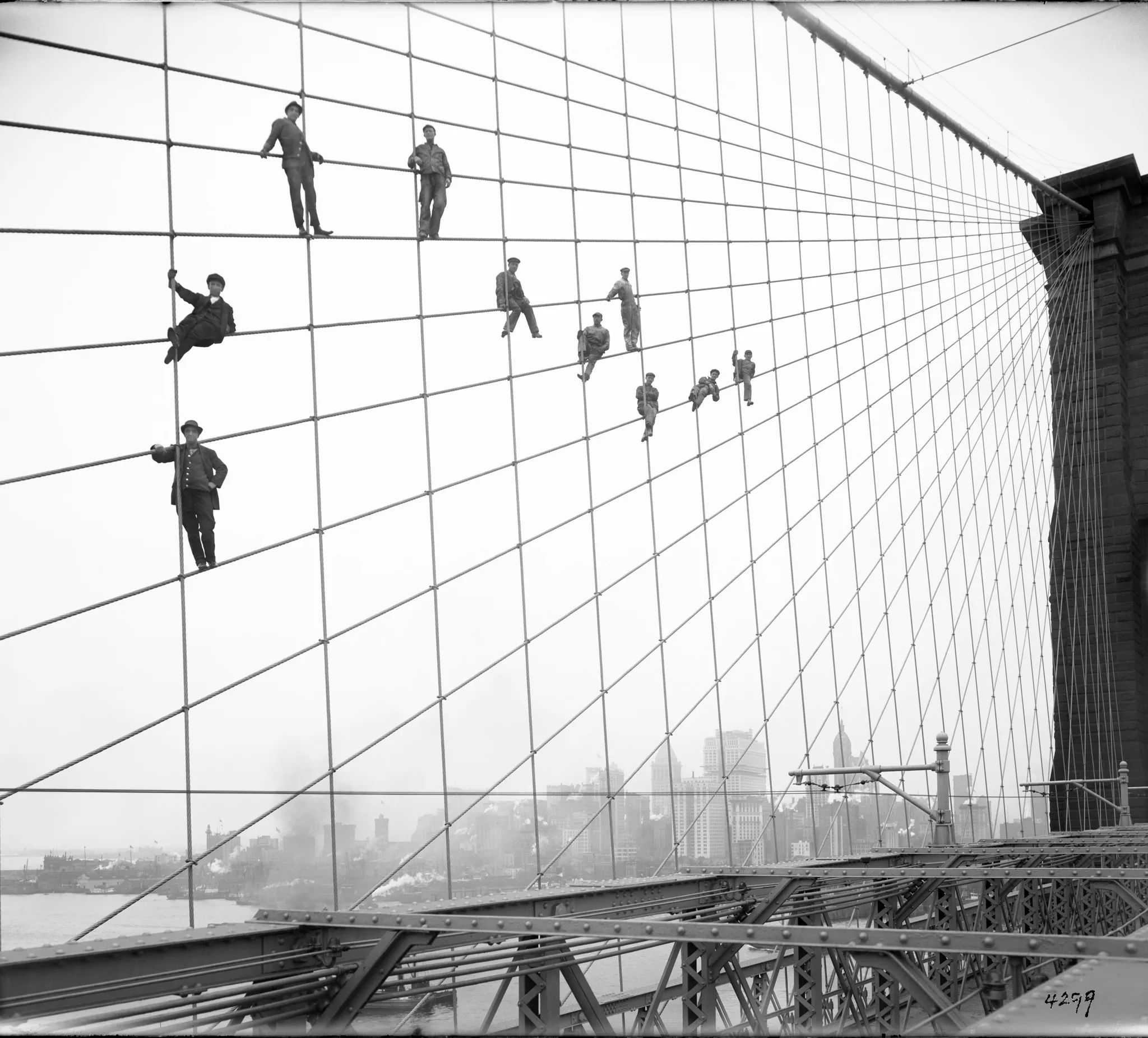
Not all of the wire was sound. The nomination records that some 221 tons (200 tonnes) of it were found deficient after it had been laid up in the cables. The builders added 152 wires beyond Roebling’s plan to make up for it. Even with the bad wire, the cables were figured to carry five times their normal load.
The web has changed since 1883. The reconstruction of 1944 to 1954 added horizontal stays between the four main cables. A later program, begun in 1980, reconditioned the main cables and replaced the suspenders and the cable stays.
The Roeblings
John A. Roebling came to America from Prussia in 1831. Before this bridge he built suspension bridges at Pittsburgh, over the Niagara gorge and at Cincinnati. In 1869 he was hurt in an accident at the Brooklyn Bridge site, contracted tetanus and died that July. His son, Washington A. Roebling, took over as chief engineer.
The towers stand on caissons, huge timber boxes with no bottoms. Filled with compressed air to keep the river out, they sank as the men inside dug away the riverbed. The Brooklyn caisson came to rest 44½ feet (13.6 m) below high water and the New York caisson 78½ feet (23.9 m) down. The depth on the New York side brought caisson disease, the bends. The official physician reported 110 cases between January and May 1872, and Roebling halted the work in the caisson after a third worker died.
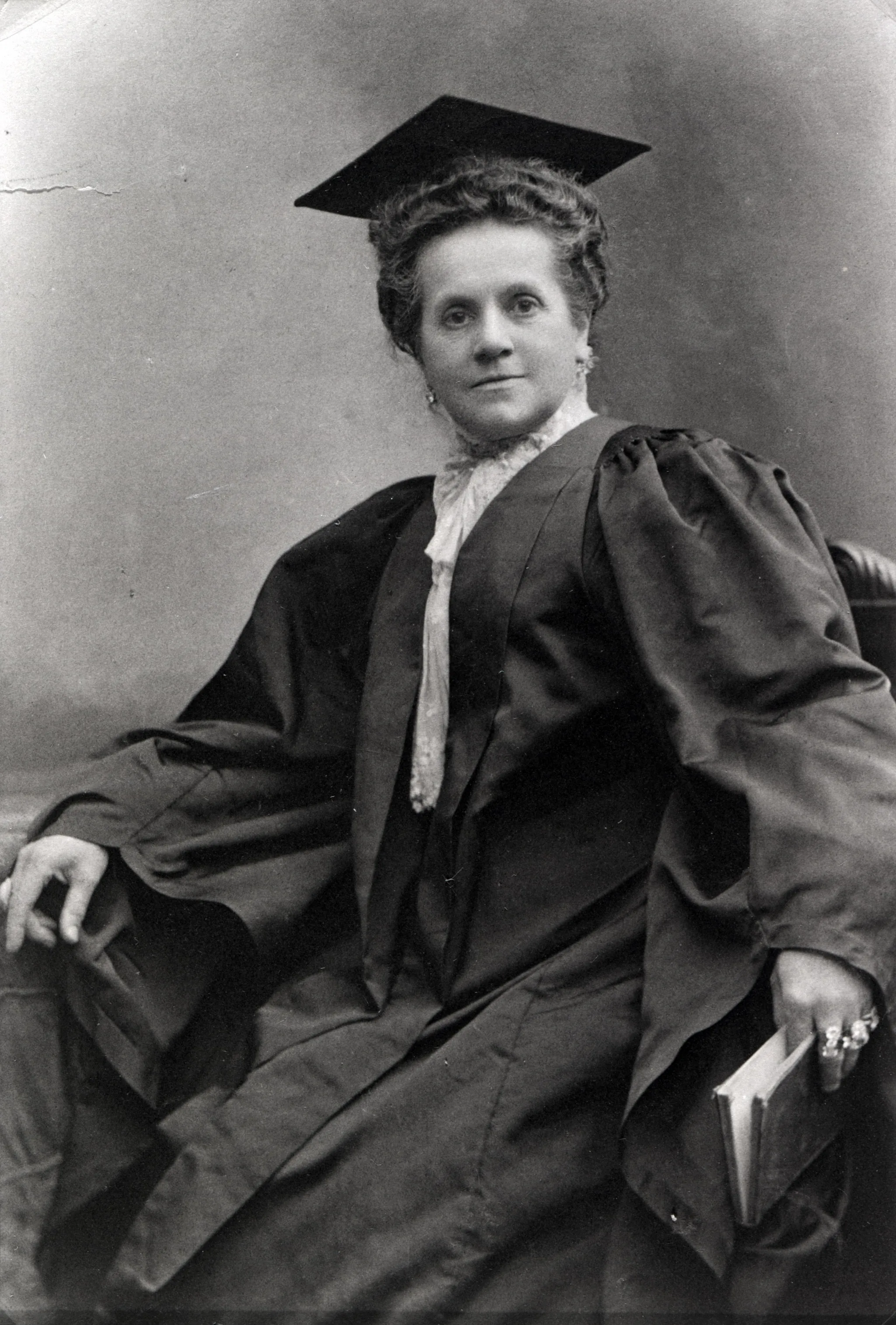
Washington Roebling went down into the caissons with his crews, and the disease left him nearly paralyzed. For years he barely left his home. He kept the title of chief engineer and followed the work through a telescope. His wife, Emily Warren Roebling, went to the site in his place. She studied his plans, wrote out his instructions for the assistant engineers, and dealt with contractors and trustees for about ten years.
The towers are limestone and granite, some of it from quarries as far away as Maine. They rise about 276 feet (84 m) above high water, and their pointed Gothic arches stand 117 feet (36 m) over the roadway. The Brooklyn tower was finished in June 1875 and the New York tower thirteen months later.
Emily Roebling was the first to cross the completed roadway. At the opening on May 24, 1883, Congressman Abram Hewitt called the bridge “an everlasting monument to the self-sacrificing devotion of a woman.” The main span measures 1,595½ feet (486 m) between the towers. No suspension bridge in the world was longer until 1903.
An everlasting monument to the self-sacrificing devotion of a woman.
Who keeps it up
The City of New York owns the bridge, and NYC DOT runs it. It became a National Historic Landmark in 1964 and a New York City landmark in 1967. The department keeps it in repair through capital projects and routine in-house work. A contract that began in September 2019 covered strengthening the masonry towers and repointing and resetting the granite, with the promenade to stay open throughout.
As of 2024, NYC DOT counts an average of 28,845 pedestrians a day on the bridge, along with 103,051 vehicles and 5,504 cyclists.
Where to see it
In Manhattan, the walkway starts across Centre Street from the Brooklyn Bridge–City Hall subway station on the 4, 5 and 6 lines. In Brooklyn it begins at Tillary Street and Boerum Place, and a staircase in the underpass at Washington Street and Prospect Street also leads up to it. Crossing is free on foot, by bike or by car, at any hour.
The bridge can also be seen from below. Brooklyn Bridge Park, run by a not-for-profit controlled by the City of New York, opened Emily Warren Roebling Plaza beneath the bridge in 2021. The two-acre (0.8-hectare) plaza is paved with concrete pavers laid in a pattern that echoes the bridge above. The park’s Empire Fulton Ferry lawn is next to it, between the Brooklyn and Manhattan bridges.
The WPA’s New York City Guide, quoted in the Landmarks Preservation Commission’s 1967 designation report, put it this way: “The promenade still draws its visitors, lyrical, noisy, or inarticulate.”
The promenade still draws its visitors, lyrical, noisy, or inarticulate.
The song
The Promenade
Alt-pop · Brooklyn indie · 2:25
On the map
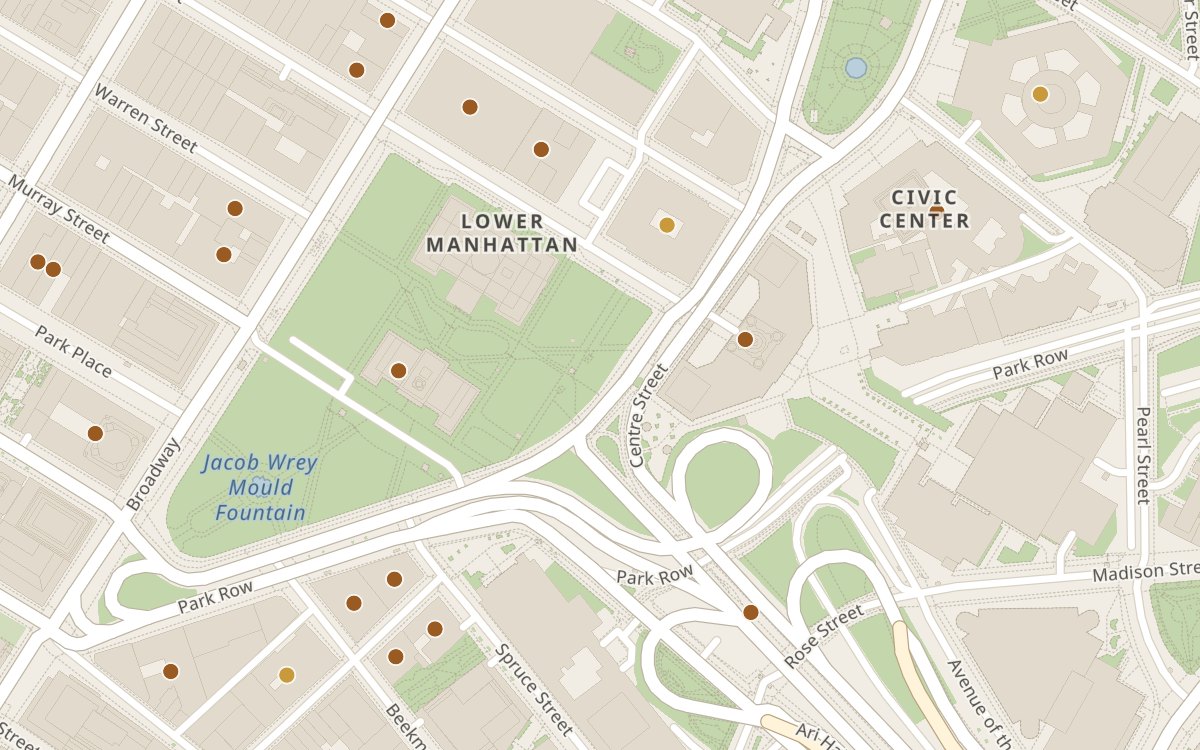
Brooklyn Bridge, from Centre Street, Manhattan. Open The Atlas →
Map: OpenFreeMap · © OpenStreetMap contributors
In the collection
 New York № 001 The Promenade Four cables carry the deck. Each holds 5,434 wires. See The Promenade →
Sources
- Brooklyn Bridge — NYC Department of Transportation
- Brooklyn Bridge Promenade (August 2016) — NYC Department of Transportation
- NYC DOT Announces New Public Safety Measures on Brooklyn Bridge to Promote Safe Travel for Pedestrians, Cyclists — NYC Department of Transportation
- 2008 Bridges and Tunnels Annual Condition Report: Innovations & Accomplishments — NYC Department of Transportation
- The Brooklyn Bridge, National Register of Historic Places Inventory–Nomination Form (1975) — National Park Service
- Brooklyn Bridge, HAER No. NY-18, Photographs and Descriptive Data — Historic American Engineering Record, Library of Congress
- Brooklyn Bridge, Designation Report LP-0098 (1967) — NYC Landmarks Preservation Commission
- Emily Warren Roebling (1843-1903) — New-York Historical Society, Women & the American Story
- Emily Warren Roebling: Building the Brooklyn Bridge and Beyond — New-York Historical Society
- Brooklyn Bridge — Brooklyn Bridge Park
- Emily Warren Roebling Plaza — Brooklyn Bridge Park
- Emily Warren Roebling Plaza Opens, Completing Brooklyn Bridge Park as Designed — Brooklyn Bridge Park
- Empire Fulton Ferry — Brooklyn Bridge Park
Images
- Opening photograph: Brandon Day, CC0 (adapted), via Wikimedia Commons
- Pedestrians on the Brooklyn Bridge promenade with trolley tracks on both sides and Manhattan buildings behind.: Library of Congress (Geo. P. Hall & Son), Public domain, via Wikimedia Commons
- Painters sitting and standing on the cables of the Brooklyn Bridge, with the Manhattan skyline behind them.: Eugene de Salignac, NYC Municipal Archives, Public domain, via Wikimedia Commons
- Seated portrait of Emily Warren Roebling in academic cap and gown, holding a book.: Photographer unknown, Public domain, via Wikimedia Commons


