New York · Journal
Why Subway Platforms Have a Bumpy Yellow Edge
The yellow strip of raised domes on New York subway platforms is a detectable warning for blind riders. What the federal rules require and how it got there.

A band of yellow runs along the edge of a New York subway platform. It is two feet (61 cm) wide and covered in rows of small, flat-topped bumps. It is called a detectable warning, and it tells a rider who cannot see the edge that the edge is close.
The strip
Federal accessibility standards describe it to the tenth of an inch. A detectable warning is “a surface of truncated domes,” meaning raised bumps with the tops cut flat. Each dome is 0.2 inch (5 mm) high. Its base measures 0.9 to 1.4 inches (23 to 36 mm) across, and its top is 50 to 65 percent as wide as the base. The domes sit on a square grid, 1.6 to 2.4 inches (41 to 61 mm) apart, center to center.
At a rail platform the surface must be 24 inches (61 cm) wide and run “the full length of the public use areas of the platform.” The rule covers boarding edges “not protected by platform screens or guards.” The same wording appears in the U.S. Access Board’s standards and in the Justice Department’s 2010 ADA Standards.
The standards do not name a color. They require only that the strip “contrast visually with adjacent walking surfaces either light-on-dark, or dark-on-light.” In New York the strip is yellow, and the MTA’s instruction to riders is short: “Remember to stay behind yellow tactile edge-warning strips on subway platforms.”
How it works
The U.S. Department of Transportation stated the purpose in 1993. The warning is there “to inform blind or visually impaired passengers that they are nearing the platform edge.” It has to differ from the platform in color and in texture. The 1991 federal guidelines added that a warning on an interior surface must differ from the floor around it “in resiliency or sound-on-cane contact.” The same guidelines recommended a contrast of at least 70 percent, measured by the light each surface reflects.
Later studies bore out the choice of the dome. In 2002 the Federal Highway Administration summed up ten years of research. Grooves, striations and exposed aggregate “were not detectable in the sidewalk and roadway environment because of the similarities to other surface textures and defects.” Truncated domes, the memo said, “can be detected underfoot and with a cane.”
The Department of Transportation gave the reason. “All it takes is a brief moment of fatigue, or distraction, or disorientation, in the complex and sometimes confusing environment of a rail station, and even a very experienced blind rail system user can make what, in context, is a fatal misstep,” it wrote. “Detectable warnings can prevent that last mistaken step.”
Even a very experienced blind rail system user can make what, in context, is a fatal misstep.
Where the rule came from
The requirement dates to 1991, when the federal accessibility guidelines written under the Americans with Disabilities Act said that platform edges “bordering a drop-off and not protected by platform screens or guard rails shall have a detectable warning,” 24 inches (61 cm) wide and “running the full length of the platform drop-off.” The Department of Transportation made those guidelines part of its own ADA regulation.
Rail systems had to make their designated key stations accessible by July 26, 1993. Rail operators had raised concerns about fitting the strips to old platforms. They worried about adhesive failures and “lift-off,” when the corners of a tile curl up and people trip on them. When the Department proposed an 18-month delay, 101 commenters objected, 80 of them disability organizations or individuals with disabilities, mostly from the blind community.
After the comment period closed, the Department also took notice of three visually impaired passengers killed at platforms without detectable warnings. One was in New York. A blind passenger using a guide dog fell from a platform and was killed by an oncoming train. That edge had been “marked with abrasive material,” which the Department understood to be a flat, painted-on surface with a sandpaper-like texture. It did not meet the federal standard.
The Department took a middle course. Its rule of November 30, 1993, moved the deadline for detectable warnings in existing key stations to July 26, 1994, and kept the requirement for new and altered platforms with no delay.
Detectable warnings elsewhere had a different history. Requirements at curb ramps and hazardous vehicular ways were suspended so their detectability could be studied, “but not for transit platform edges,” the highway administration noted. That suspension ran until July 26, 2001.
In New York
In a November 2023 report, the New York City Public Advocate listed “high-contrast tactile strips along the edges of train platforms and at the top of stairs” among the features the MTA already provided. The report also noted that not every station had all of them.
Federal standards require the strips at new and altered stations and at key stations. The Public Advocate reported that the MTA had adopted a policy of adding platform edge strips at other stations too, but that “there are still many stations without them.”
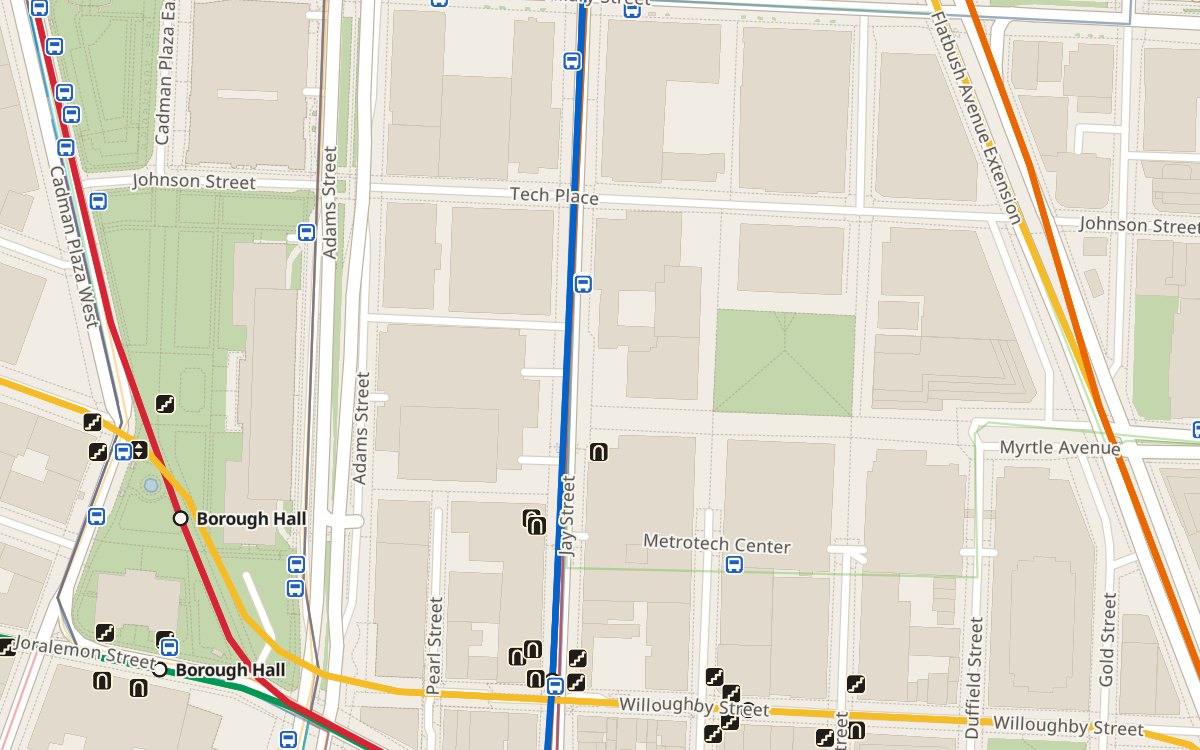
From October 16, 2019, to January 17, 2020, the MTA used Jay St–MetroTech in Brooklyn as an Accessible Station Lab. It tested more than a dozen features there, among them tactile guideways and stair warnings, and the MTA says the physical features remain at the station.
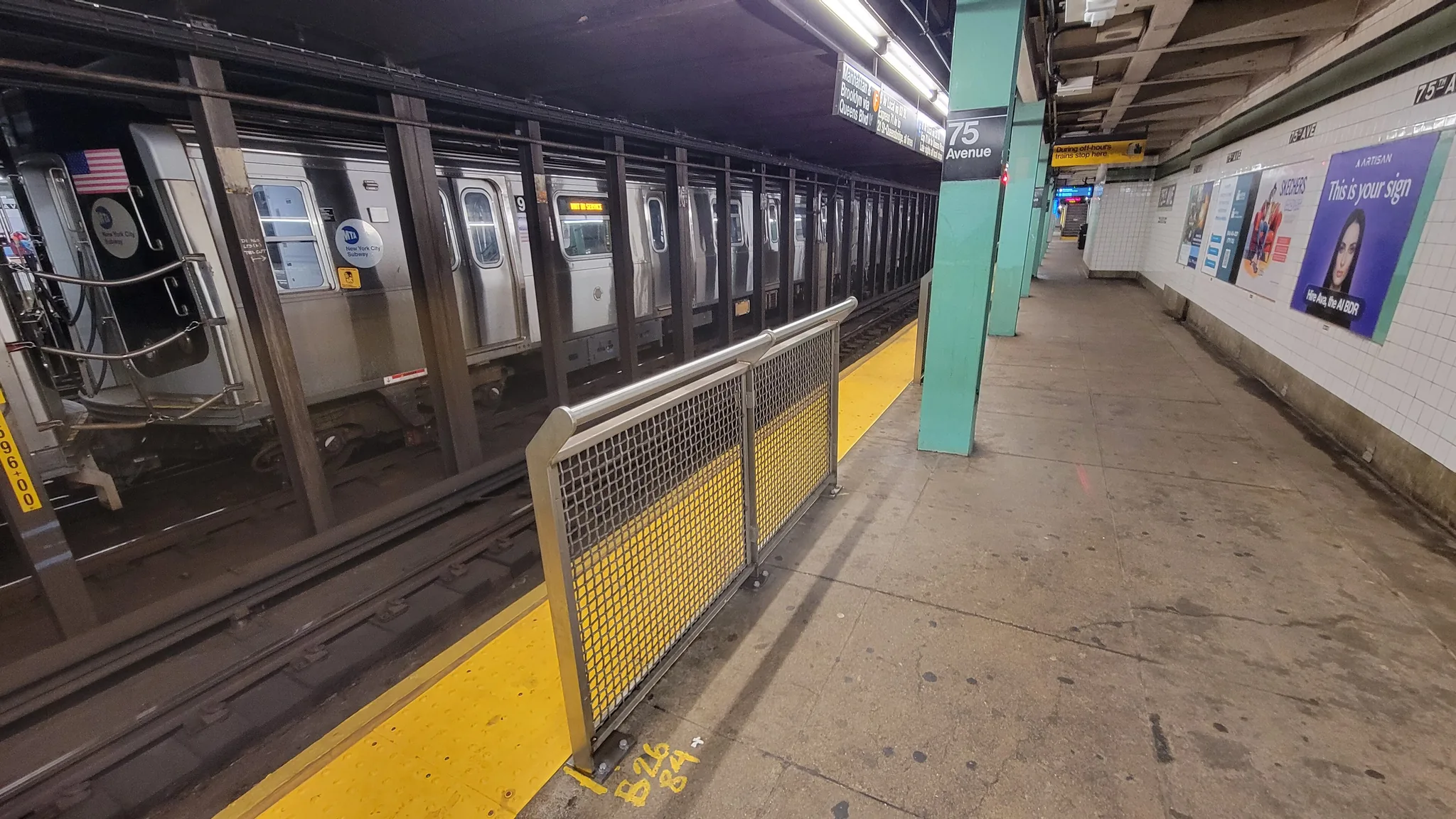
In January 2024 the MTA completed its first installation of platform barriers. The agency describes them as “waist-high guardrails positioned in front of the yellow strip and at points along the subway platform where riders can easily enter and exit the train.” By the end of June 2026 it counted 158 stations with barriers.
Where to see it
Jay St–MetroTech in Brooklyn is where the MTA ran its Accessible Station Lab, and the physical features remain at the station. A photograph in the Public Advocate’s report shows “a brightly colored yellow tactile strip at the top of the stairs.” Where platform barriers have gone in, as at Woodhaven Boulevard on the M and R, 23rd Street on the C and E and 77th Street on the 6, riders quoted by the MTA describe them. A rider at 77th Street said: “Instead of getting too close to the tracks to see if the train is coming you can just stand behind the barriers.”
The song
The Platform Edge
UK garage · alt-pop · 2:30
On the map
Jay St–MetroTech station, Brooklyn. Open The Atlas →
Map: OpenFreeMap · © OpenStreetMap contributors
In the collection
 New York № 001 The Platform Edge Two feet (61 cm) of yellow. Five millimeters you can feel. See The Platform Edge →
Sources
- 2010 ADA Standards for Accessible Design — U.S. Department of Justice
- ADA Accessibility Standards — U.S. Access Board
- ADA Accessibility Guidelines (ADAAG), 1991–2002 — U.S. Access Board
- Transportation for Individuals with Disabilities: Detectable Warnings, Standees on Lifts, Equivalent Facilitation, Priority Seating, Rail Car Acquisition (58 FR 63092, 1993) — Federal Transit Administration
- INFORMATION: ADAAG Detectable Warnings (memorandum, May 6, 2002) — Federal Highway Administration
- Accessible Travel by Subway — Metropolitan Transportation Authority
- Accessible Station Lab — Metropolitan Transportation Authority
- The Policy Brief: How platform barriers make the subway safer — Metropolitan Transportation Authority
- Out of Service: Creating an Equitable Transit System for New York City — New York City Public Advocate
Images
- Opening photograph: Dillan Payne, CC BY-SA 4.0, via Wikimedia Commons
- A worker in a hard hat and safety vest lifts a yellow tile of raised domes from a subway platform edge.: Metropolitan Transportation Authority of the State of New York, CC BY 2.0, via Wikimedia Commons
- A waist-high barrier with a mesh panel stands in front of the yellow strip on a subway platform.: Tdorante10, CC BY-SA 4.0, via Wikimedia Commons


