New York · Journal
The Subway's Mosaic Station Names: How New York Put Its Stops in Tile
Why New York's oldest subway stations spell their names in mosaic, who made the tile, how the tablets were set, and which stations still show them.

In New York’s older subway stations, the name of the stop is spelled out on the wall in small pieces of colored tile: white letters on a field of blue or green, inside a patterned border. These are the mosaic name tablets. They were set into the walls of the city’s first subway line, and several are protected as part of a city landmark.
Name tablets
A mosaic, in the New York Transit Museum’s definition, is “a surface decoration made by inlaying small pieces of variously colored material to form pictures or patterns.” The pieces are called tesserae. The IRT company’s 1904 account of its new subway lists where ceramic mosaic went: “decorative panels, friezes, pilasters, and name-tablets.”
The Landmarks Preservation Commission describes the layout. “Large name tablets of mosaic or faience are set into the middle of the wall panels,” below a cornice that holds smaller plaques with a symbol or letter for the station. The Historic American Engineering Record says the full station name appeared on “large tablets of either mosaic tile, faience, or terra-cotta at frequent intervals.” The tablets the commission recorded share a formula: white letters on a colored field, inside a border that changes from station to station.
Why the names were set in tile
The architects, Heins & LaFarge, wanted each station to look different. According to the engineering record, they made “a conscious effort” to give every station its own wall treatment, “both to relieve monotony and assist in the identification of different locations.” The commission concluded that each station’s identity “was created through the use of color, symbolic plaques, and name tablets.”
Both to relieve monotony and assist in the identification of different locations.
The name was built into the wall rather than hung on it. The 1904 account notes that at some stations the number of the cross street, or the first letter of its name, appeared on “conspicuous plaques.” Lighted signs were a separate job, and the Pulsifer & Larson Company made them for the express stations. At 72nd Street, an express stop with only an island platform, the walls have no name tablets at all. There, the commission notes, signs on the platform “were intended to state the location.”
How the tablets were made
The records call the material encaustic mosaic tile. The engineering record says it was used “for the color bands and name tablets” and names one manufacturer for the colored mosaic tile on the first line: the American Encaustic Tile Company. Each station’s tile subcontractor set it in place. The record’s station inventory lists John H. Parry at 33rd Street and at 110th Street, for example, and the Alfred Boote Company at 79th Street.
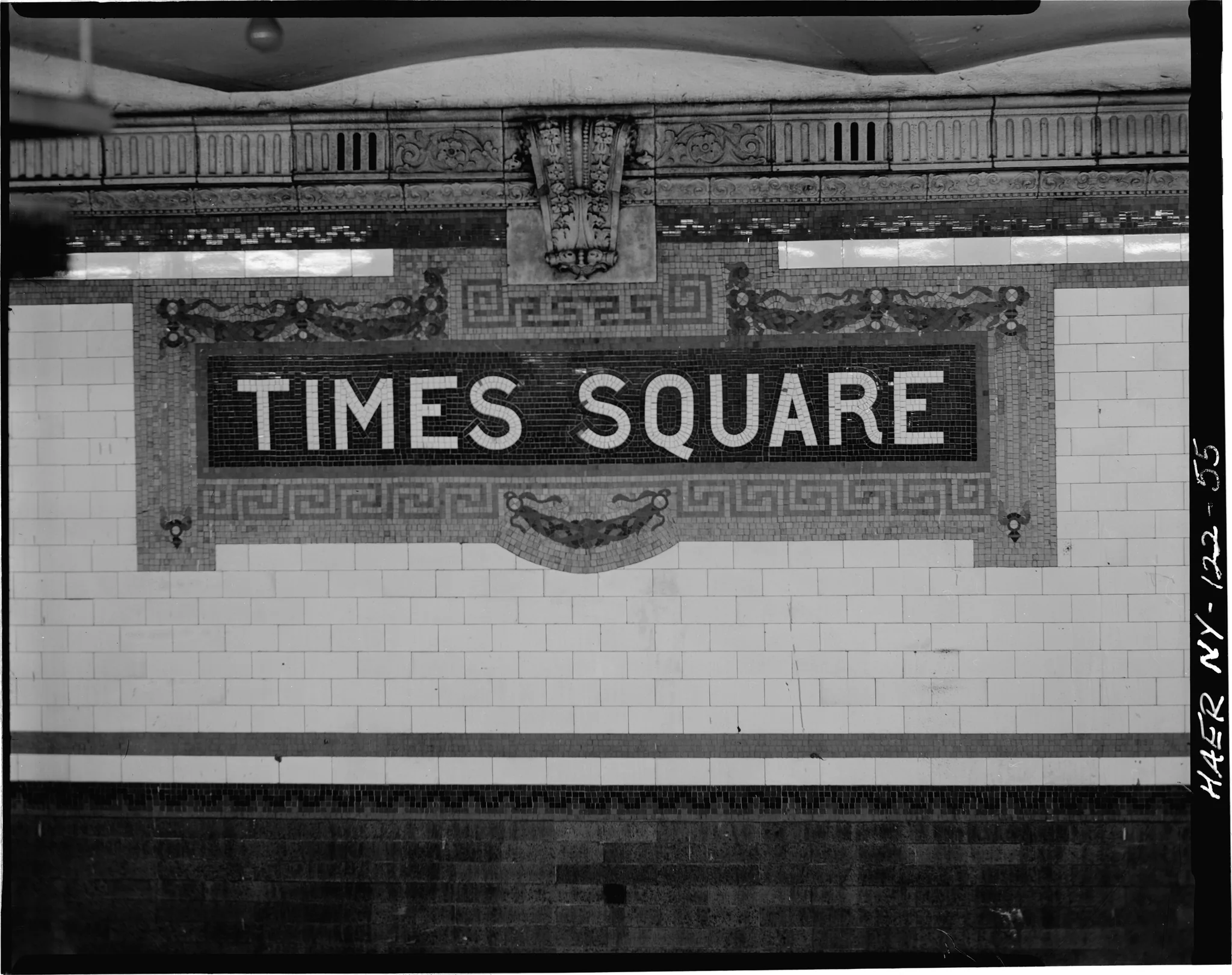
Encaustic tile, the National Park Service explains in its guidance on historic tile, is unglazed, with its pattern made in the clay rather than applied to the surface. Unglazed tiles take their color “solely from the clay, or from oxides, dyes or pigments added to the clay.” Ceramic mosaic of the period came in pieces from half an inch to a little over two inches (1.3 to a little over 5 cm) across. It was made unglazed, “in solid or variegated colors with a matte finish,” and also glazed.
Setting it became easier with time. By the 1920s, the Park Service notes, small ceramic mosaic was made in 12-inch (30 cm) square sheets held together by a paper “skin” on the face. A setter could lay a square foot (0.09 m²) at once, and the paper stayed on until the tiles were firmly set in the cement.
After the first line
The subway’s chief architect from 1906 to 1942 was Squire J. Vickers. The Transit Museum writes that in his stations “curves gave way to straight lines and faience to vividly colored mosaic tiles and geometric designs,” and that he left “signature tile station plaques” across the system.
At the Chambers Street IRT station at West Broadway, Columbia Magazine reports, Vickers’s terra-cotta plaques show College Hall, the home of King’s College, the school that became Columbia. They went up in 1918, and each wall carries thirty copies.
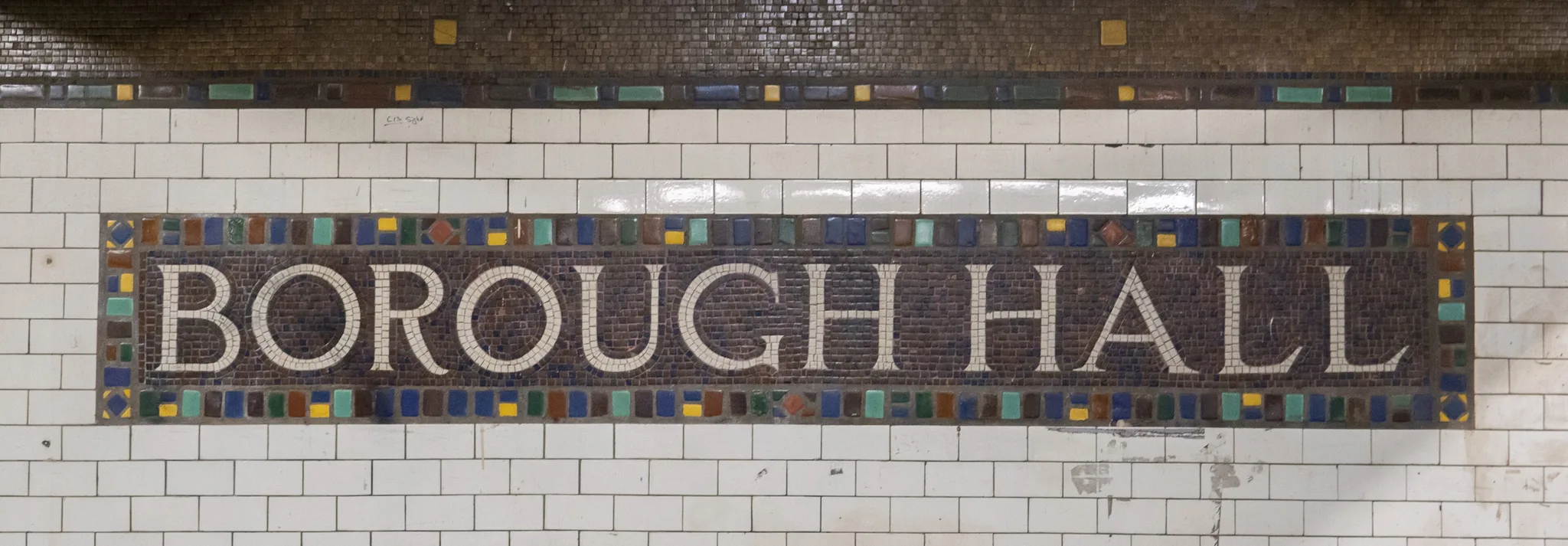
In the 1930s Vickers pared the design back further. The Transit Museum describes “simple colored bands of tiles along the walls of the stations with the name of the station in a clear sans-serif font for easy readability.”
Keeping them
In 1984, when the Transit Authority announced a $2.5 million restoration of Astor Place, the Times described the work as “replacing tiles, repiecing mosaics, improving lighting and installing equipment to lower noise.” When the work was celebrated in 1986, the station also had new mosaics by the designer Milton Glaser. He said he had taken the motifs from the original tiles, “enlarged them, and made an abstract sort of variation.” Since 1979 the mosaic tile in parts of twelve original stations has been protected as a city interior landmark.
New mosaic still goes into the system. MTA Arts & Design, formed in the 1980s according to the Transit Museum, lists “more than 350 artworks in mosaic, glass, metal, and more” installed throughout the system.
Where to see it
The Landmarks Preservation Commission’s 1979 report describes the tablets station by station.
- Borough Hall, Brooklyn: white letters on dark green mosaic, inside a wide border of swags in dark red, blue, buff, pink, violet and green.
- Fulton Street, Lexington Avenue line: blue field, border of vines and bellflowers.
- 33rd Street: blue mosaic framed in buff and green.
- 79th Street: green mosaic in a buff and green frame.
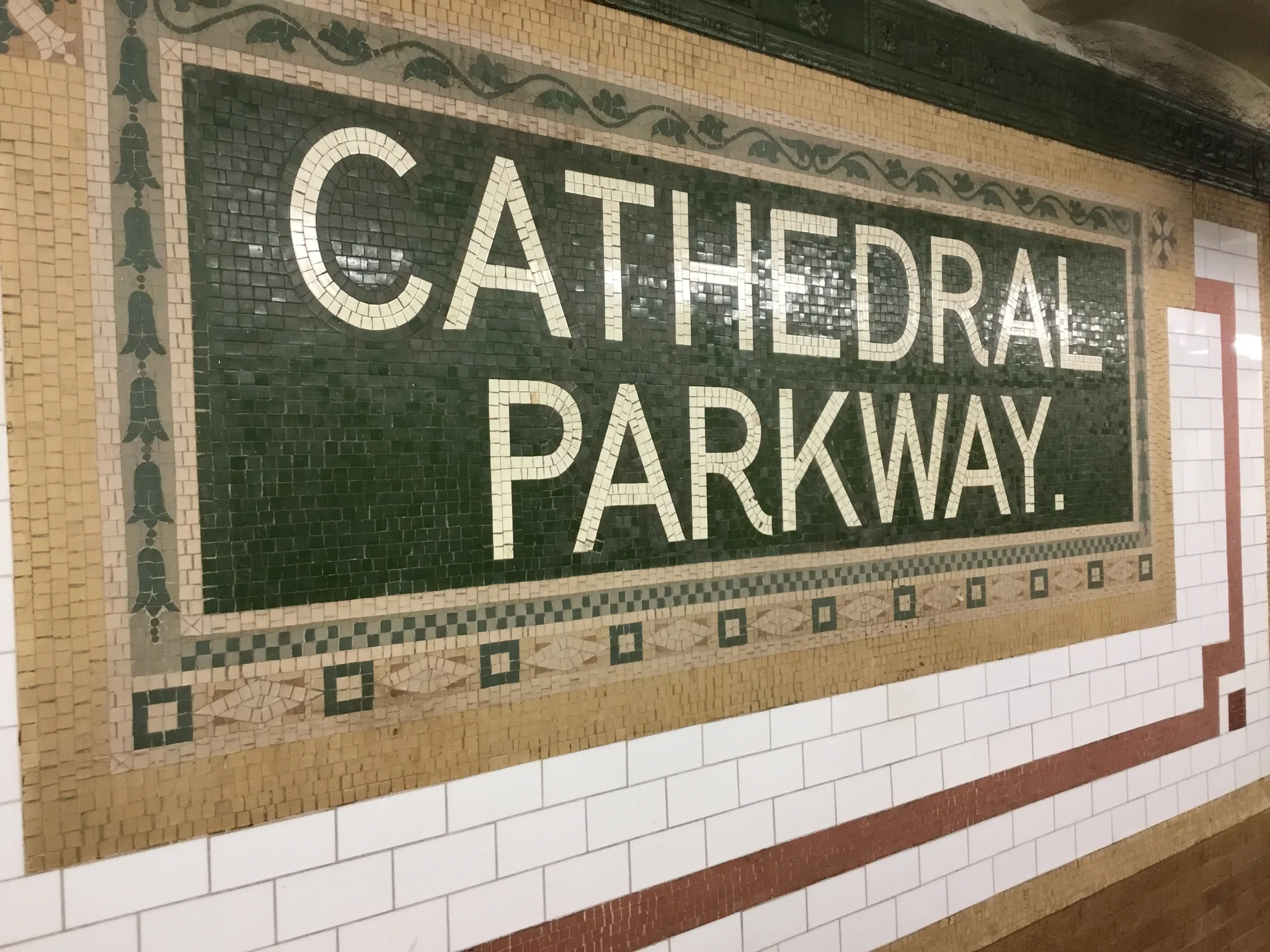
- 110th Street: “Cathedral Parkway” spelled on green mosaic, bordered with flowers, leaves and geometric shapes in buff, pink and red.
- Columbus Circle: two kinds of tablet, one in green mosaic and one in green faience.
- 116th Street: the tablets read “Columbia University,” white on blue.
- Bleecker Street and Astor Place: faience, white letters on blue.
The engineering record’s 1978 inventory adds black tablets at 23rd Street and red ones at 96th Street. The Transit Museum also points to a mosaic plaque at Canal Street on the N and R, which it credits to Jan Van Everen. It shows the canal running under the Stone Bridge, with the Stone Bridge Tavern that stood at Broadway and Canal Street in the late 1700s.
The song
The Mosaic
Organic house · 2:32
On the map
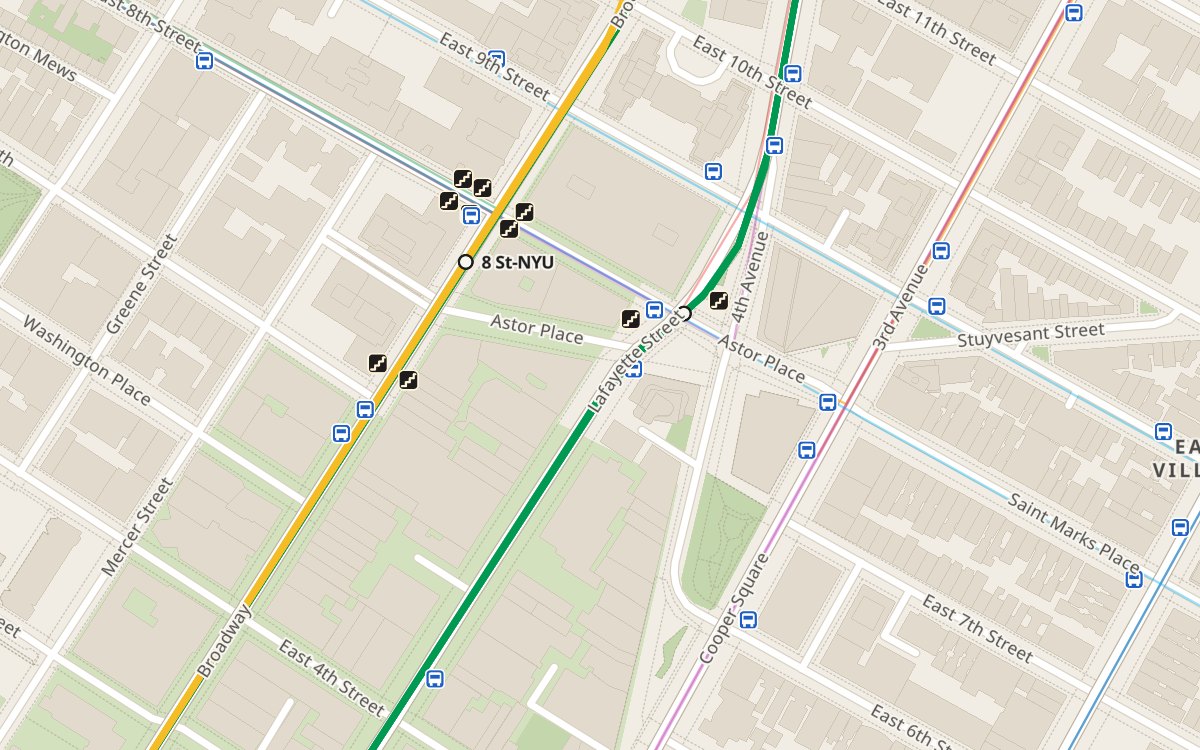
Astor Place station, Manhattan. Open The Atlas →
Map: OpenFreeMap · © OpenStreetMap contributors
In the collection
 New York № 001 The Mosaic A station name, assembled one tile at a time. See The Mosaic →
Sources
- IRT Subway System Underground Interior, Designation Report LP-1096 (1979) — New York City Landmarks Preservation Commission
- Interborough Rapid Transit Subway (Original Line), HAER NY-122, including David J. Framberger, "Architectural Designs for New York's First Subway" (1978) — Historic American Engineering Record, National Park Service; Library of Congress
- Interborough Rapid Transit: The New York Subway, Its Construction and Equipment (1904) — Interborough Rapid Transit Company, Project Gutenberg edition
- Preservation Brief 40: Preserving Historic Ceramic Tile Floors — National Park Service
- Miles of Tiles: Background Information for Teachers — New York Transit Museum
- Station Identification — Columbia Magazine, Columbia University
- Station at Astor Place Slated for Restoration — The New York Times
- Refurbishing of IRT Station Applauded by Well-Wishers — The New York Times
- MTA Arts & Design — Metropolitan Transportation Authority
Images
- Opening photograph: Kevin Payravi, CC BY-SA 4.0, via Wikimedia Commons
- A mosaic name tablet reading Times Square, white letters on a dark field, set in a white tile wall below a terra-cotta cornice.: Historic American Engineering Record (HAER NY-122), Library of Congress, Public domain, via Wikimedia Commons
- A mosaic name tablet reading Borough Hall in white letters, with a border of small colored tiles, on a white tile wall.: GeneralPunger, CC BY-SA 4.0, via Wikimedia Commons
- A mosaic name tablet reading Cathedral Parkway in white letters on a green field, with a buff border.: Kidfly182, CC BY-SA 4.0, via Wikimedia Commons


