New York · Journal
Why New York Has So Many Sidewalk Sheds
What a New York sidewalk shed is, the facade law behind most of them, how many stand and for how long, and the city's new rules to take them down.

New York has thousands of sidewalk sheds, the pipe-and-plywood roofs over its sidewalks that are sometimes called scaffolding. More of them go up under one city law than for any other reason: tall buildings must have their walls inspected, and a shed follows when an inspector finds an unsafe facade. They are built to be temporary, and many stay for years.
What a sidewalk shed is
The Department of Buildings calls sidewalk sheds “temporary structures built to protect people or property.” An owner must put one up when constructing a building more than 40 feet (12 m) high, when demolishing one more than 25 feet (7.6 m) high, and whenever danger calls for that kind of protection. The rule for taking one down is a single line. Sheds “must be removed immediately once construction, demolition or remediation work is complete.”
An engineering report prepared for the department in 2025 notes that sheds are also called “scaffolding,” “bridges” or “canopies.” The word scaffolding usually means protection that climbs the full height of a building during construction. The shed is the part at street level, over the sidewalk and the entrances.

For years the Building Code fixed the color. A department notice from August 2025 says the code “previously required sidewalk sheds” to be hunter green, with an allowance for some to be white. Under Local Law 47 of 2025, in effect since August 15, 2025, any shed may be hunter green, metallic gray or white. At an existing building that is not being demolished or heavily altered, a shed may also match the facade, trim or cornice.
The facade law
In 1979 a Barnard College student, Grace Gold, was killed in Manhattan by a piece of masonry that fell from a building. The City Council answered with Local Law 10 of 1980, the first law to require periodic facade inspections in New York. Local Law 11 of 1998 expanded it, and the inspections still go by that name.
The rules are short. Owners of buildings taller than six stories must have their exterior walls inspected every five years and file a report with the department. The inspector, a Qualified Exterior Wall Inspector, must be a New York State licensed professional engineer or registered architect. The owner hires the inspector. The city does not. Each facade is rated safe, safe with a repair and maintenance program, or unsafe. When it is unsafe, “the owner must immediately install protection, such as a sidewalk shed.”
The city counted about 16,000 buildings under the program in 2023. The department’s consultant counted about 17,000 in the inspection cycle that began in February 2025. In 2023 the Mayor’s Office said a plurality of the city’s sheds went up in connection with the program.
A shed stays until the unsafe conditions are fixed. The 2025 report found that sheds “may linger for many years because the owner does not have the financial means to perform the required repairs in a timely manner.”
May linger for many years because the owner does not have the financial means to perform the required repairs in a timely manner.
How many, and how long
In July 2023 the city counted about 9,000 active, permitted sheds with an average age of nearly 500 days. Together they ran more than 2 million linear feet (610 km), nearly 400 miles (640 km), or about 3 percent of the city’s sidewalk space. A 2023 report from the Manhattan Borough President’s office put the average at 498 days and counted more than 230 sheds that had been up for over five years.
The city owns its share. As of September 2025, city buildings accounted for 59 of about 380 miles (95 of about 610 km) of active sheds, about 16 percent, according to the engineering report.
At 409 Edgecombe Avenue in Harlem, a shed stood longer than any other in the city. The building is a city landmark that was once home to W.E.B. Du Bois and Thurgood Marshall. The shed went up in 2002, after an engineer hired by the owners found unsafe conditions in the brick and terra-cotta facade. For about 20 years the owner made no repairs. The city filed criminal charges against the management company in 2019. The shed came down in December 2023, after 21 years.
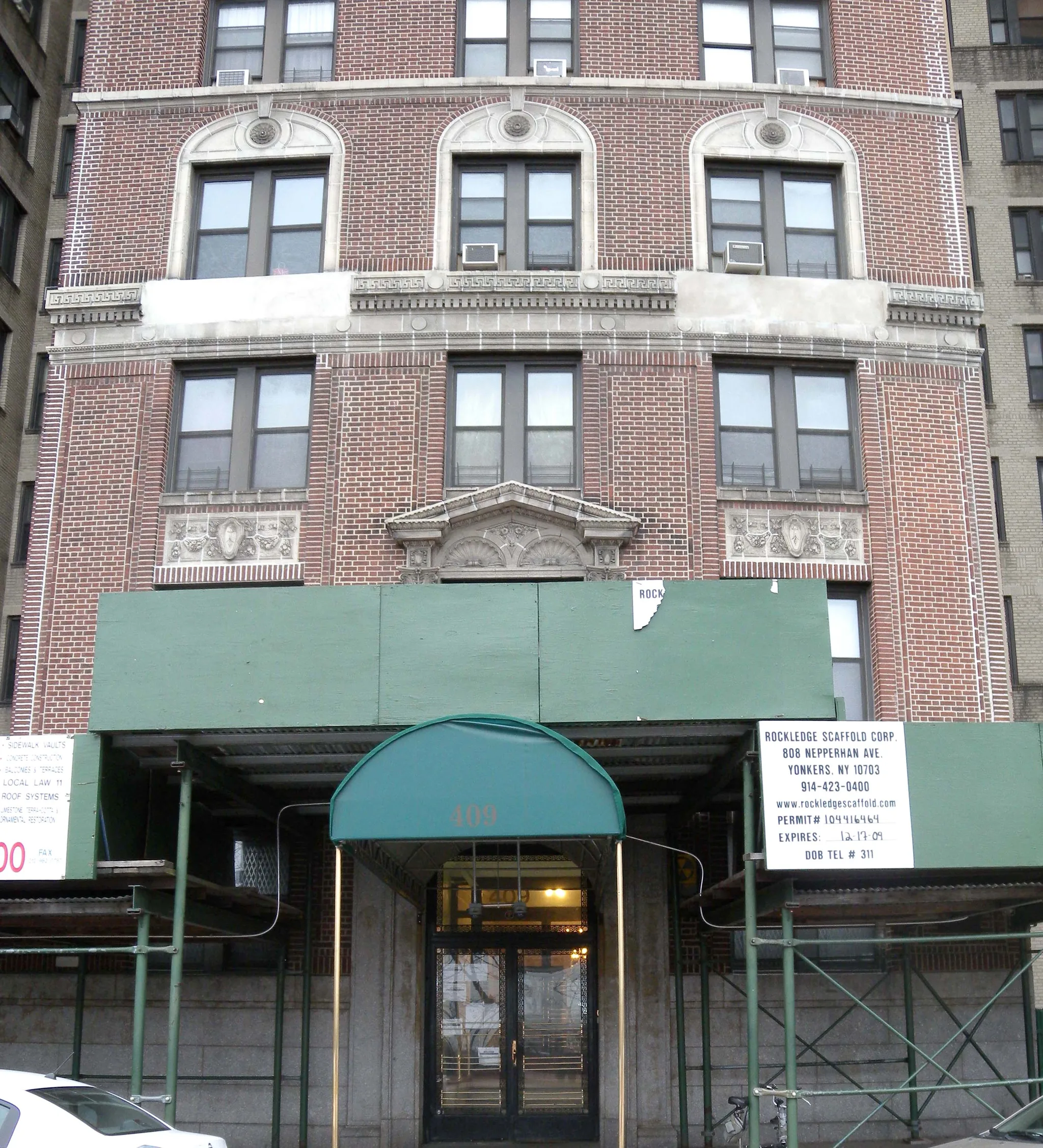
As of August 17, 2026, the city counted 7,427 permitted sheds. That is more than 1,000 fewer than a year earlier.
New rules and new designs
Mayor Eric Adams announced a plan called “Get Sheds Down” in July 2023. In April 2025 he signed Council bills that carried much of it into law. In August 2026 the Department of Buildings finalized rules under those laws. A shed permit, once renewed every year, must now be renewed every 90 days, and each renewal must report the progress of the repair that keeps the shed up. Owners who keep a shed up past 180 days without real progress on repairs face monthly penalties that grow with the size and age of the shed. The department expects to begin imposing them in early 2027.
Other changes shrink the shed. On large campus properties, such as public housing, required coverage is being limited to 40 feet (12 m) from a building. The department also plans to move facade inspections from every five years to every six, with hands-on inspections as rarely as every 12 years for lower-risk, well-kept buildings.
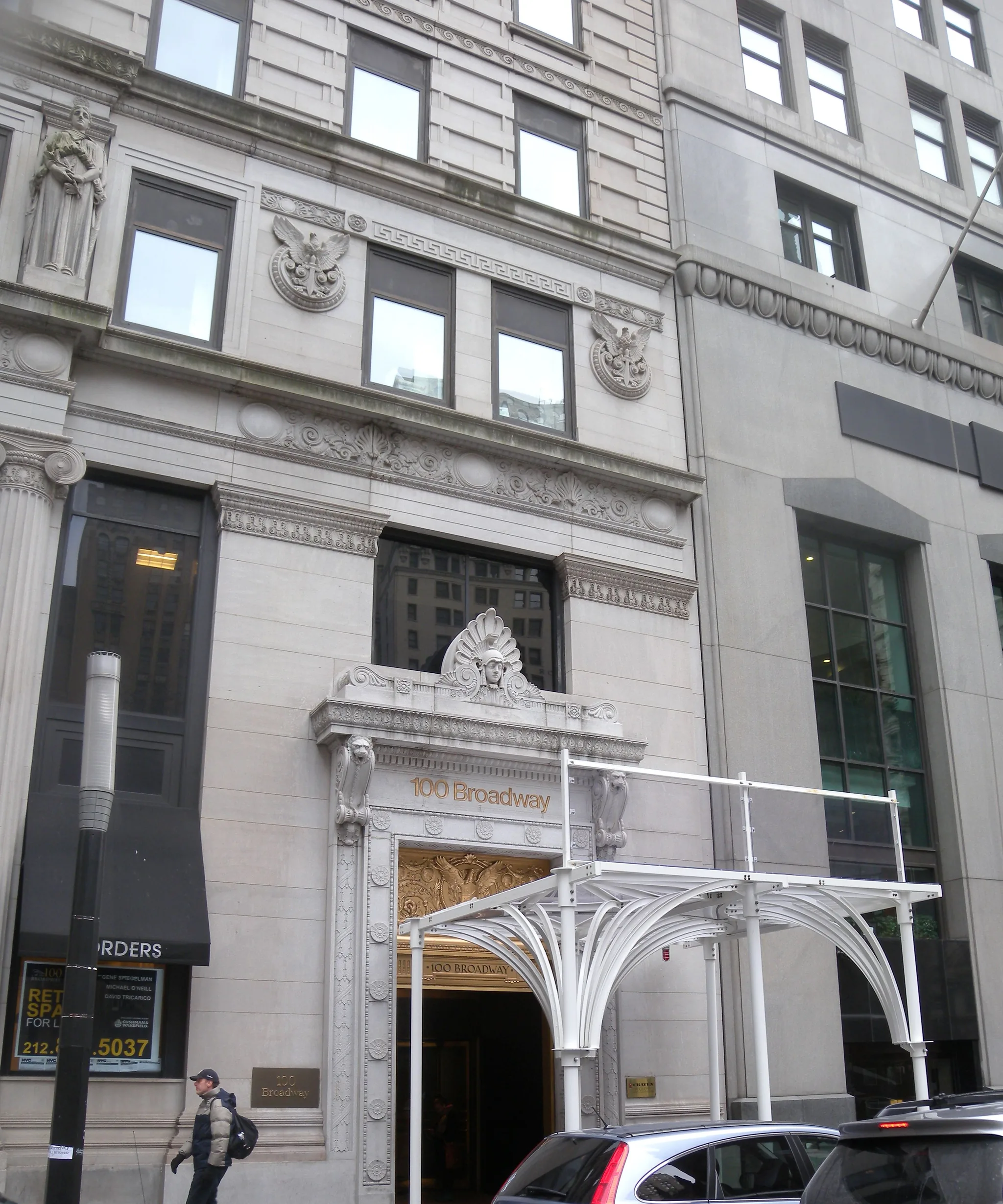
The design itself is changing. A 2011 city press release said the sidewalk shed “had not been updated in more than 60 years.” The city’s urbanSHED competition, whose winner was announced in January 2010, drew 164 designs from 28 countries. It was won by Young-Hwan Choi, a University of Pennsylvania student, working with Sarrah Khan and Andrés Cortés. A prototype of his Urban Umbrella went up at 100 Broadway in 2011. In February 2024 the city hired two firms, Arup and Practice for Architecture and Urbanism, to design new sheds. Their six designs were shown in November 2025. They run from the Speed Shed, a light shed that is quick to put up and quick to move, to the Air Shed, which is lifted off the ground and anchored to the building like a balcony. In August 2026 the department proposed rules to allow all six across the city. Public comment closed on September 24.
Who keeps watch
Under the facade program, the private engineers and architects who inspect a building also say what protection an unsafe facade needs. City inspectors work on the other end. The department’s Sidewalk Shed Monitoring and Removal Unit, at 280 Broadway, oversees buildings whose sheds have stood for more than five years. Its inspectors examine the facades behind them and take enforcement action when owners do not make repairs.
The New York City Housing Authority is repairing its own buildings. It is spending $650 million in state and federal money on facade repairs at 40 developments. By March 2026, sheds had come down at more than 200 of its buildings.
Where to see it
On almost any street. The Department of Buildings keeps a public map of every actively permitted shed, updated daily, that can be filtered by age. Most facade filings come from Manhattan, because most of the city’s buildings taller than six stories are there.
The song
Temporary
Indie pop-rock · 2:30
On the map
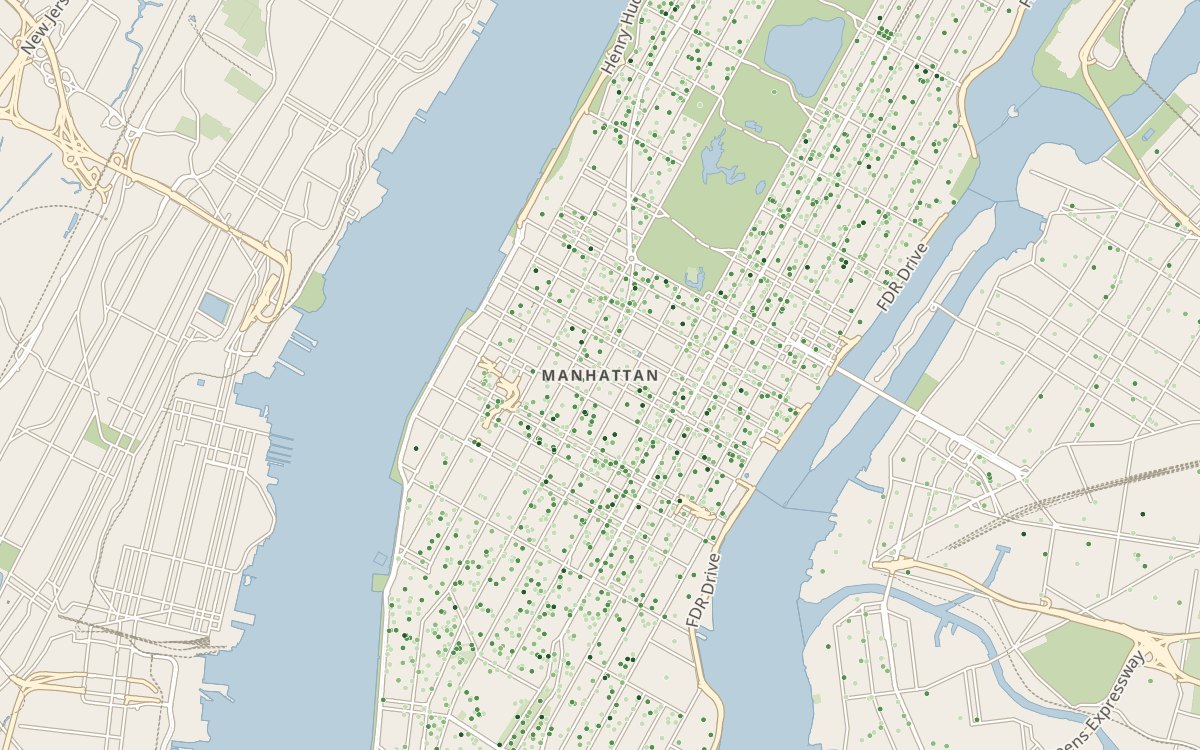
Mostly Manhattan. Open The Atlas →
Map: OpenFreeMap · © OpenStreetMap contributors
In the collection
 New York № 001 Temporary Pipe and plywood over the sidewalk. One stood for 21 years. See Temporary →
Sources
- Sidewalk Sheds — NYC Department of Buildings
- Façade & Local Law — NYC Department of Buildings
- FISP Statistics — NYC Department of Buildings
- FISP Recommendations Report: A Review of the New York City Façade Inspection & Safety Program (Thornton Tomasetti) — NYC Department of Buildings
- Department of Buildings Launches Study to Reevaluate Façade Inspection Regulations in New York City — NYC Department of Buildings
- Transcript of the Minutes, Committee on Housing and Buildings, April 25, 2024 — New York City Council
- Industry Notice: New Color Options for Sidewalk Sheds and Fences — NYC Department of Buildings
- Mayor Adams, DOB Commissioner Oddo Unveil Plan to Remove Unsightly Sheds, Scaffolding From NYC Sidewalks — NYC Mayor's Office
- Shed the Shed — Manhattan Borough President
- Mayor Adams Takes Down City's Longest-Standing Sidewalk Shed, Scaffolding — NYC Mayor's Office
- Mayor Adams Signs Historic Legislation to 'Get Sheds Down,' Remove Unsightly Scaffolding Across Five Boroughs — NYC Mayor's Office
- Mayor Adams Unveils New Designs for Sidewalk Sheds and Scaffolding That Will Beautify Streets, Make City Safer — NYC Mayor's Office
- Mayor Mamdani Launches New Efforts to Take Sidewalk Sheds Down, Require Fewer Unnecessary Sheds — NYC Mayor's Office
- Mamdani Administration Taking Down Sidewalk Sheds and Improving Design of New Sheds — NYC Mayor's Office
- Sidewalk Shed Monitoring & Removal — NYC Department of Buildings
- Active Sidewalk Shed Permits — NYC Department of Buildings
- Mayor Bloomberg, Buildings Commissioner LiMandri and Designers Unveil City's New State-of-the-Art Sidewalk Shed — NYC Office of the Mayor
- Buildings News, February 9, 2010 — NYC Department of Buildings
Images
- Opening photograph: Thomson200, CC0, via Wikimedia Commons
- A brick apartment house with a green sidewalk shed of plywood and steel pipe over its entrance.: Jim Henderson, Public domain, via Wikimedia Commons
- A white arched sidewalk shed over the ornate stone entrance of 100 Broadway.: Jim Henderson, CC0, via Wikimedia Commons


