New York · Journal
The Black-and-White Cookie: A New York Cake That Calls Itself a Cookie
What a New York black-and-white cookie is, how the batter and fondant icing work, how Glaser's Bake Shop in Yorkville is tied to it, and how people eat one.

A black-and-white cookie is iced in two halves, one chocolate and one vanilla. It is sold in bakeries and delis across New York. By the account of the New York Times, it is not a cookie at all.
What it is
The New York Times described it in 1998 as “the oversize black-and-white cookie, a New York standby that is sold in bakeries and delis all over the city.” The writer, William Grimes, then gave the technical ruling: “Technically, the black-and-white is not a cookie but a drop cake.”
Technically, the black-and-white is not a cookie but a drop cake.
The name comes from the method. The batter resembles the batter for a cupcake, with a little extra flour so that the dough does not run across the baking sheet. It is dropped on the sheet dollop by dollop, which is what makes it a drop cake. Once baked, the Times wrote, it “is iced with chocolate and vanilla fondant frosting.”

The flour is the careful part. Herb Glaser, the baker at Glaser Bake Shop on First Avenue near 87th Street, told Grimes: “The trick is to add enough flour so the batter holds a shape, but not so much that the cookie becomes dry.” Dryness, Grimes noted, is a common problem with the black-and-white. When the bakery closed in 2018, ABC7 New York reported that Glaser said there was no secret ingredient, just patience and being careful not to overbake.
How it is made
The recipe printed with the 1998 article shows how plain the parts are. The dough is built from sugar, butter, eggs, milk, vanilla extract and a little lemon extract. The flour is a mix of cake flour and all-purpose flour, with baking powder and salt. Heaping spoonfuls of dough go onto the baking sheets two inches (5 cm) apart. They bake at 375 degrees (190°C) for 18 to 20 minutes, until the edges begin to brown. The recipe yields two dozen large cookies and calls for the cookies to cool completely before they are iced.
The icing starts with confectioners’ sugar stirred with boiling water into a thick, spreadable mixture. Half of it is warmed with bittersweet chocolate and a teaspoon of light corn syrup over simmering water, and the chocolate frosting is kept over the hot water so it stays spreadable. With a brush, half of the top of each cookie is coated in chocolate frosting and the other half in white. The cookies then dry and are stored in an airtight container.
Glaser's Bake Shop
One bakery is tied to the black-and-white more closely than any other in print: Glaser’s, in Yorkville on Manhattan’s Upper East Side. ABC7 reported that the bakery was opened in 1902 by German immigrants. 6sqft added that John Glaser opened what was then primarily a bread shop, at a time when Yorkville was known as Germantown. A caption in the Village Voice credits the founding of the family business to John and Justine Glaser.
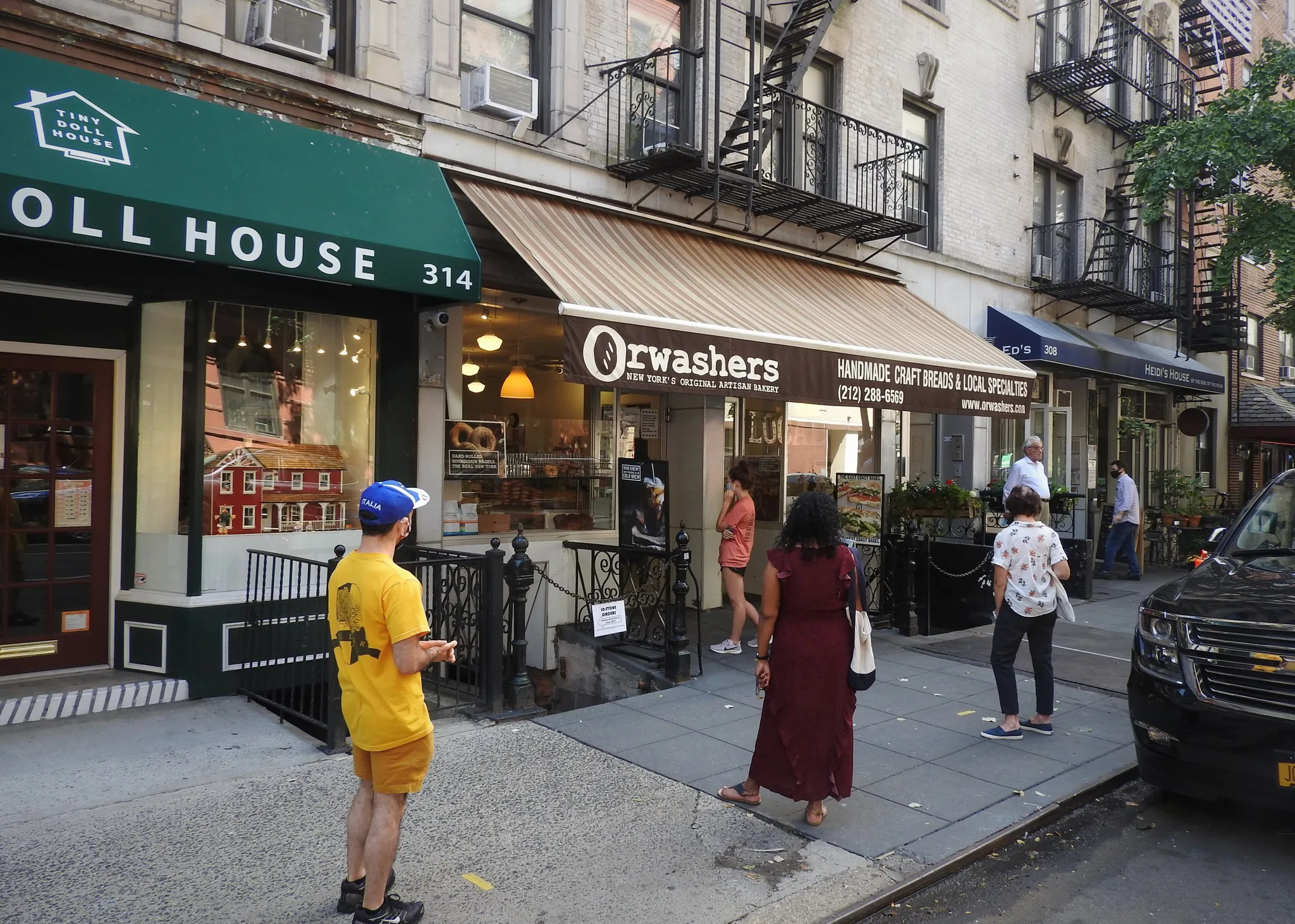
In 1998 Herb Glaser told the Times that, as far as he knew, Glaser’s had been making black-and-whites ever since it opened 96 years earlier. That is a baker’s recollection of his own shop, not a claim that it invented the cookie. ABC7 called the Glasers “the fabled creators of the treat” and reported that Herb Glaser said he would not claim ownership.
Glaser’s kept going for 116 years. It was run in its last years by the third generation, brothers Herb and John Glaser. Herb Glaser told 6sqft that the business lasted because his grandfather “had the foresight and the ability to buy the building that we are in.” The bakery closed on Sunday, July 1, 2018. The Village Voice described its black-and-whites as “lavishly frosted” and called the cookie “perhaps the most iconic example of New York City’s most iconic cookie.”
How people eat one
The cookie comes with an etiquette, and it is about order. Rochelle Udell, then editor in chief of Self magazine, whose family owned Ratchik’s bakery in Brooklyn, told the Times: “The black-and-white always asked the question, Which side do you start with first?”
The black-and-white always asked the question, Which side do you start with first?
Cara De Silva, a food writer who grew up in Washington Heights, remembered the appeal as simple: “The lure of the cookie was that it was both vanilla and chocolate.” In the Times article the eating takes several forms. A soft frosting can be licked off. A brittler frosting can be lifted from the cake in small chunks. The cookie can be split into a black half and a white half, or kept whole and eaten with alternating bites from each side.
Herb Glaser has his own answer. According to ABC7, he eats the vanilla first, so he can save the best part, the chocolate, for last.
Where to see one
It sits in the glass case of a neighborhood bakery and at the counter of a deli. The 1998 Times article put the black-and-white in “bakeries and delis all over the city,” and the same piece advised against settling for “a stale shrink-wrapped cookie.”
Glaser’s is gone, but the Times did not tie the cookie to one address. It called it a New York standby, and the people it quoted remembered it from Brooklyn and Washington Heights as well as Yorkville.
The song
The Black and White
Club pop · electroclash · 2:36
In the collection
 New York № 001 The Black and White Two halves, two icings. More cake than cookie. See The Black and White →
Sources
- 'Look to the Cookie': An Ode in Black and White — William Grimes, The New York Times, May 13, 1998
- Glaser's Bake Shop, 116-year-old bakery known for black-and-white cookie, closes — ABC7 New York
- The Black and White Cookie at the End of the World — Molly Fitzpatrick, The Village Voice, July 6, 2018
- 116-year-old Yorkville bakery Glaser's announces summer closing — 6sqft
Images
- Opening photograph: BrillLyle, CC0, via Wikimedia Commons
- A bakery storefront with a striped awning on a Yorkville street, with people on the sidewalk.: Jim.henderson, CC BY-SA 4.0, via Wikimedia Commons

