New York · Journal
Schmear: The Yiddish Word for Cream Cheese on a Bagel
How schmear, New York shorthand for cream cheese on a bagel, came from Yiddish, what else it has meant, and where the cheese itself began.

In New York, a bagel “with a schmear” comes with a layer of cream cheese. The word came into English from Yiddish. It has meant more than one thing, and the cheese on the bagel started on a dairy farm in New York State.
What the word means
The dictionaries agree on the breakfast sense. The American Heritage Dictionary defines schmear as “a portion of cream cheese or another spread, as on a bagel.” Merriam-Webster gives “a layer of a spreadable food or condiment,” and adds “especially : a layer of cream cheese.” Cambridge’s example sentence is the order itself: “My favorite snack is a bagel with a schmear.”

American Heritage labels the word slang, Merriam-Webster calls it informal, and Cambridge marks it as American. The Oxford English Dictionary says it is used in North American English. The spelling varies. Merriam-Webster lists schmeer as a variant, and American Heritage accepts both schmeer and shmear.
A usage example on Merriam-Webster’s page, taken from a piece by Laura Mallonee, shows the word in use. It quotes a man who spent four years in the city starting in the late 1980s: “No one said, ‘Let me get a bagel with cream cheese,’” he recalled. “It was ‘plain with a schmear.’”
From Yiddish shmir
American Heritage traces schmear to Yiddish shmir, “smear, smudge,” from the verb shmirn, “to smear, grease.” Before that, it goes back to Middle High German smiren and Old High German smirwen. Merriam-Webster’s etymology is a shorter version of the same thing. Collins derives the word from Yiddish shmirn, “to smear or grease.”
The Oxford English Dictionary treats the verb as the older form. It records schmear the verb as a borrowing from Yiddish shmirn, and schmear the noun as formed in English from that verb.
Dates and older senses
The earliest English evidence the OED cites does not come from New York. Its first citation for the verb is from 1882, in the Daily Northwestern of Oshkosh, Wisconsin. Its earliest evidence for the noun is from 1909, in a letter by S. H. Latzer.
Merriam-Webster also dates the noun to 1909, but it gives that date to a sense other than the spread: “a group of related things.” That is the sense in “the whole schmear,” which a Merriam-Webster example glosses as “the entire thing, everything.” Cambridge defines the idiom as “the whole of something, or everything that is related to or connected with something,” and gives the example “He took me to dinner, dancing, the whole schmear.”
The OED dates the noun’s use in connection with cheese to the 1910s, and its use in economics and commerce to the 1950s. Other dictionaries record a blunter meaning. Collins, drawing on Webster’s New World, lists “a bribe” as a sense of the noun. The Jewish English Lexicon compiled by Sarah Bunin Benor lists both “a bribe” and “to bribe.”
The bagel under the schmear
Smithsonian magazine reports that bagels came to the United States with Eastern European immigrants in the late nineteenth century. They stayed mostly in Jewish markets until the 1970s, when they moved into the mainstream. In a 2003 survey of the city’s bagels for The New York Times, Ed Levine describes them being baked on the Lower East Side and sold on the street “stacked on sticks.”
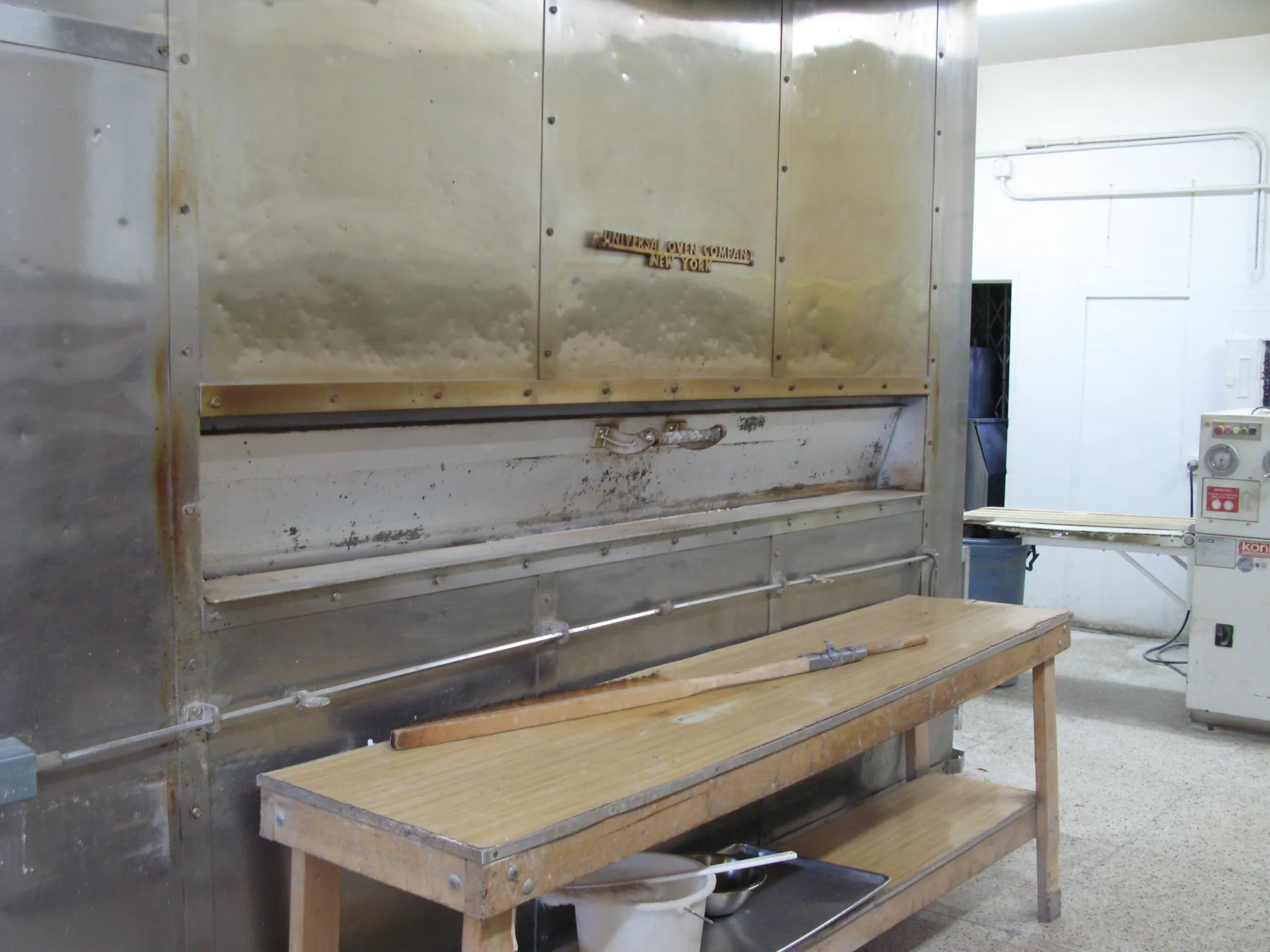
Levine describes the union that made the city’s bagels, Bagel Bakers Local 338, “a federation of nearly 300 bagel craftsmen formed in Manhattan in the early 1900’s.” New membership was limited to the sons of current members. Union bagels weighed about three ounces (85 g) and were made by hand from high-gluten flour, water, yeast, salt and malt syrup.
The union showed its strength in December 1951. The Times reported that the metropolitan area was “threatened with a bagel famine” because 32 of the city’s 34 bagel bakeries had stayed closed in a dispute involving 300 members of Local 338. In 1960 a Times headline put New York’s production at some 250,000 bagels a day. Machines changed the trade. Levine writes that industrial bagel machines reached the market in the early 1960s and let any retail bakery make bagels with nonunion help.
Bagels do not need six ounces of cream cheese on them. They only need a schmear.
His advice on the spread is short: “Bagels do not need six ounces of cream cheese on them. They only need a schmear.”
Cream cheese from Orange County
The cream cheese brand named for Philadelphia began in New York State. William A. Lawrence (1842–1911) was a dairy farmer in Orange County. He first made Neufchâtel, a French cheese, and began making cream cheese in the 1870s, after the New York grocer Park & Tilford persuaded him to make a simpler product. His obituary, held by the Chester Historical Society, puts his early output at two boxes a day and his output in 1911 at over two thousand.
In 1880 Lawrence joined forces with Alvah Reynolds, a distributor, who sold the cheese as Philadelphia Cream Cheese. The Encyclopedia of Greater Philadelphia, published by Rutgers University, says Reynolds chose the name to link Lawrence’s product “with high-quality foods.” Kraft’s own account, quoted in The Washington Post in 2006, gives the same reason: at the time, top-quality foods were often called “Philadelphia quality.” The Chester Historical Society notes that the brand was first produced in Lawrence’s factory in Chester, New York. Reynolds sold it to the Phenix Cheese Company of New York in 1903, and Phenix merged with Kraft in 1928.
The bagel and the cheese came together as a business in 1984, when Kraft bought Lender’s Bagels. Smithsonian magazine cites Maria Balinska’s book The Bagel: The Surprising History of a Modest Bread, which says the merger “was billed as ‘the wedding of the century.’”
Despite the name on the package, the Encyclopedia of Greater Philadelphia says, “cream cheese became indelibly associated with New York because of its pairing with bagels and use as an ingredient in New York-style cheesecake.”
The song
Schmear
Retro-pop · klezmer swing · 2:32
In the collection
 New York Schmear A layer of cream cheese. A word from Yiddish. See Schmear →
Sources
- schmear — The American Heritage Dictionary of the English Language
- Schmear Definition & Meaning — Merriam-Webster
- SCHMEAR | English meaning — Cambridge Dictionary
- schmear, n. — Oxford English Dictionary
- schmear, v. — Oxford English Dictionary
- Schmear definition and meaning — Collins English Dictionary
- schmear — Jewish English Lexicon
- A Brief History of the Bagel — Smithsonian Magazine
- Was Life Better When Bagels Were Smaller? — The New York Times
- Bagel Famine Threatens in City; Labor Dispute Puts Hole in Supply — The New York Times
- About: Bagels; Some 250,000 of the tooth-cracking breakfast goodies are produced in New York each day — The New York Times
- William A. Lawrence Succumbs to Paralysis — Chester Historical Society, New York Heritage Digital Collections
- Philadelphia Cream Cheese — The Encyclopedia of Greater Philadelphia (Rutgers University)
- Comparing Cream Cheeses — The Washington Post
Images
- Opening photograph: Berenice Abbott (New York Public Library), Public domain, via Wikimedia Commons
- A large steel baking oven with a wooden work table and peel in front of it.: evan p. cordes, CC BY 2.0, via Wikimedia Commons

