New York · Journal
Regular Coffee: The New York Order That Isn't Black
At a New York deli counter, a "regular" coffee comes with milk and sugar. What the order means, where it means something else, and the cup it came in.

At a New York deli counter, a regular coffee is not black. It has milk in it, and sugar. Gothamist stated the rule in 2012: “A regular coffee is a coffee with cream (or milk) and two sugars.” The same piece placed the order “usually at a deli/corner store/bodega.”
What the counter hears
In this usage “regular” describes what goes into the cup, whatever the size or the roast.

When the New York Post asked why a “regular” coffee had come to mean “with milk and sugar,” Joseph DeRupo, a spokesman for the National Coffee Association, answered, “I think it’s a part of New York jargon,” according to Gothamist’s account of the exchange.
Gothamist also pointed to a 1998 episode of Law & Order as evidence of the city’s “changing coffee climate.” A coffee shop clerk offers Detective Lennie Briscoe a free large latte. He asks for “a regular coffee” instead. The clerk asks how he would like it. Briscoe answers: “Uh, regular?”
Where regular means something else
Elsewhere, the same word can mean the opposite. In its 2013–2014 survey, the Dictionary of American Regional English asked: “If you order your coffee ‘regular,’ it comes (with) ________.” The most common answer was “black,” given 20 times. Cream or milk with sugar, in various wordings, came up six times. Other respondents wrote “nothing” or “caffeine.” The question was new; it had not been asked in the dictionary’s 1965–70 survey.
New England comes closest to New York. In 2014 Boston.com called Dunkin’ Donuts locations across the region and reported that around Boston, “coffee regular” means “coffee with cream and sugar.” A medium, one Connecticut employee said, has “three cream, three sugar,” the standard answer at most of the New England stores the reporters reached.
That agreement broke down in New York State. A worker at a Dunkin’ in Mamaroneck told them: “Some people think ‘coffee regular’ means black, some people think it means cream and sugar, some people think it means milk and sugar.”
Employees in Connecticut said the confusion came mostly from out-of-towners. “Down south, it means ‘black,’” one said. Another said some customers take “regular” to mean “not decaf.”
The cup on the counter
The cup that long held deli and cart coffee in New York has a history of its own. The Associated Press described it in 2010 as “a blue, white and gold cardboard cup with an ancient Grecian design.” It was the work of Leslie Buck, who was born in Khust, then part of Czechoslovakia and now in Ukraine. He survived Auschwitz and Buchenwald and left Europe after his parents died in the Holocaust. In New York he started a paper-cup company, Premier Cup, in Mount Vernon.
In the 1960s he joined the Sherri Cup Company of Kensington, Connecticut. WNYC described him as a marketer there, with no design experience, and not Greek. In the middle of the twentieth century, WNYC noted, “the diner and corner vendor business in New York City was dominated by Greek immigrants.” Buck made a cup for them, and starting in the 1960s decorated it with Greek urns, images of coffee cups and the words “We Are Happy To Serve You” in lettering that resembled ancient Greek. Gothamist reported: “Noticing that many diner owners were Greek, he used their colors as inspiration and designed the cup himself.”
He called it the Anthora. The name came from the word amphora, a kind of urn, as Buck pronounced it in his accented English.
The design “soon spilled into the streets, used by vendors peddling coffee on chilly days,” the AP wrote. Customers drank from hundreds of millions of the cups over the decades. They became standard props in films set in New York and in television shows such as Law & Order, and imitators added columns and discus throwers.
They kept buying it because it was the symbol of New York.
The people behind the counter changed, and the cup stayed. Sarah Henry of the Museum of the City of New York told WNYC in 2012: “Even after the ethnic succession really was underway and new immigrants were running both the diners and the corner delis, they kept buying the [Anthora] coffee cup and they kept buying it because it was the symbol of New York.”
Buck died in April 2010 at his home in Glen Cove, Long Island, at 87, of complications of Parkinson’s disease. By then Solo Cup Company, which had taken over Sherri, made the original only on special order. The design had moved onto T-shirts and ceramic mugs, and the Museum of Modern Art had started selling ceramic mug versions of the paper cup.
The song
Regular Coffee
Synth-pop · freestyle · 2:29
In the collection
 New York Regular Coffee Milk and two sugars. Regular describes what goes in. See Regular Coffee →
Sources
- Why A "Regular Coffee" Means Coffee With Cream And Sugar — Gothamist
- H74d — Dictionary of American Regional English, University of Wisconsin–Madison
- At Dunkin' Donuts, 'Coffee Regular' Has a Limit. And that Limit is New York State — Boston.com
- NY Coffee Cup Creator Leslie Buck Dies at 87 — CBS News (Associated Press)
- "Happy to Serve You" Cup Creator Dies at 87 — Gothamist
- Object #1: The Greek Coffee Cup — WNYC
Images
- Opening photograph: Bain News Service (Library of Congress), Public domain, via Wikimedia Commons
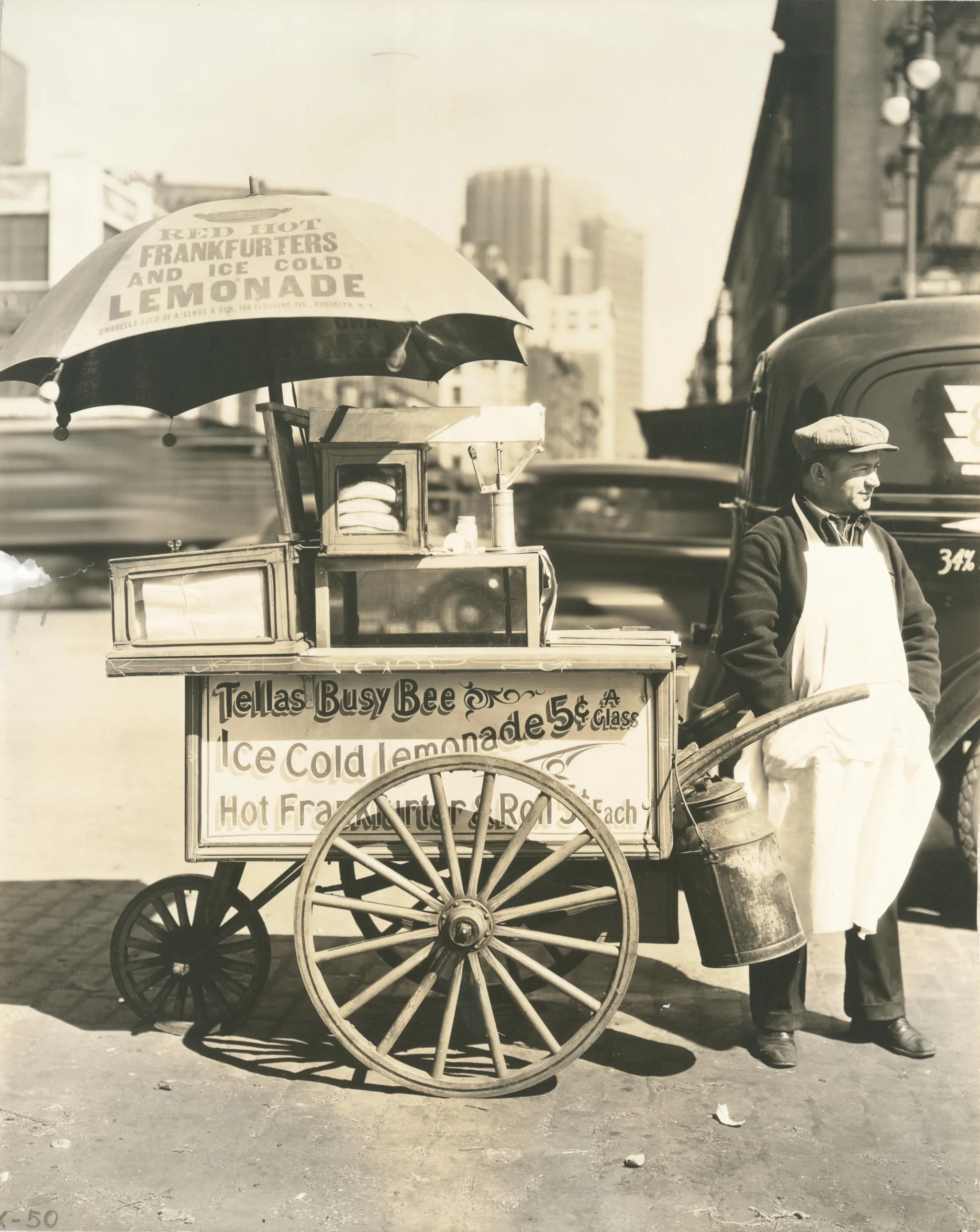
- A street vendor in an apron stands beside his wheeled food cart under an umbrella, traffic blurred behind him.: Berenice Abbott (New York Public Library), Public domain, via Wikimedia Commons

